The Best Stitches for Scarves: What Lies Flat and Looks Good on Both Sides
A scarf shows both faces of the fabric and has free-hanging edges, so the stitch matters. Here are the traditional stitches that lie flat, with the stitch count each one needs.
A scarf is unusual among knitted things: both faces of the fabric are on show, nothing is seamed or hemmed, and the two long edges hang free for five feet or more. A stitch pattern that looks wonderful on the front of a sweater can be a poor choice here. The stitches below are the traditional ones that suit a scarf, with the reasons each one works and the stitch count it needs.
What makes a stitch scarf-friendly
Three properties matter more than how pretty a swatch looks.
- It lies flat. Fabrics that mix knit and purl stitches on the same face are balanced and stay flat. Fabrics with all the knits on one face and all the purls on the other roll toward the knit side.
- It looks good on both sides. A scarf twists as you wear it, so the “wrong side” is seen constantly. The safest stitches are identical on both faces, or at least attractive on both.
- It is easy to memorize. A scarf is hundreds of rows long. A repeat of one to four rows that you can read from the stitches already on the needle is far more pleasant than one that needs a row counter and a printed chart.
A fourth point is worth knowing before you buy yarn: rib and textured stitches use more yarn than garter for the same width and length, so check the yardage against the stitch you have chosen.
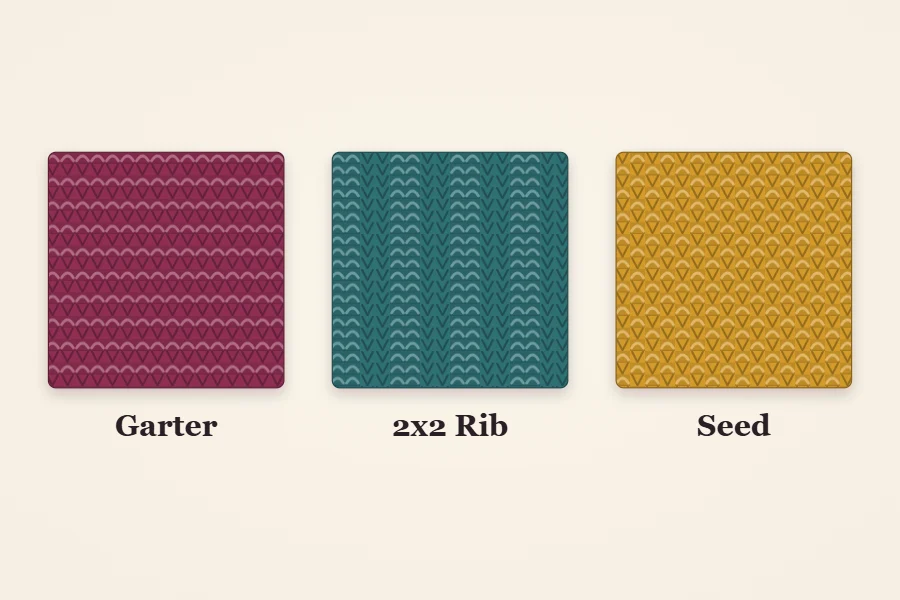
Garter stitch: the default
Garter stitch is made by knitting every row. Two rows form one raised ridge, the fabric lies completely flat, and both sides are the same. It works on any number of stitches, so you can cast on (CO) whatever gives the width you want. The fabric is thick, springy and warm, and it stretches a little lengthwise under its own weight.
Because there is only one stitch to learn, garter is where most knitters start, and it is the stitch used in the classic garter stitch scarf pattern. Its one weakness is that uneven tension shows at the side edges, which a slipped first stitch tidies up.
Rib stitches: 1×1, 2×2 and mistake rib
Ribbing stacks knit stitches (k) and purl stitches (p) in vertical columns. The columns pull together, so the fabric is stretchy and narrower than garter over the same number of stitches. You need to cast on more stitches for a given width, and the scarf uses more yarn.
1×1 rib
Worked over an odd number of stitches (sts). Row 1, the right side (RS): k1, *p1, k1* to the end. Row 2, the wrong side (WS): p1, *k1, p1* to the end. The fabric is fine-grained and very elastic.
2×2 rib
Worked over a multiple of 4 plus 2, such as 30 or 34 stitches. Row 1 (RS): k2, *p2, k2*. Row 2 (WS): p2, *k2, p2*. The extra 2 stitches make both edges match. The wider columns are easier to read than 1×1, which is why the 2×2 ribbed scarf is a common second project.
Mistake rib
Worked over a multiple of 4 plus 3, such as 27 or 31 stitches. Every row is the same: *k2, p2* to the last 3 stitches, k2, p1. The odd stitch count shifts each row by one stitch, which produces deep, slightly offset ribs. It is fully reversible, and a single-row repeat is hard to lose your place in. The mistake rib scarf pattern has the full numbers.
Seed stitch and moss stitch
Seed stitch alternates knit and purl like 1×1 rib, but offsets them on every row so that each knit sits on top of a purl. The result is a flat, pebbly fabric that does not pull in. Over an odd number of stitches every row is identical: k1, *p1, k1*. It is the same on both sides and has crisp edges, which makes a seed stitch scarf a good choice when you want something neater than garter.
Moss stitch, in US terms, is the four-row cousin. Over an even number of stitches, Rows 1 and 2 are *k1, p1* and Rows 3 and 4 are *p1, k1*. Each knit and purl is two rows tall, so the texture is a little bolder and more diagonal. Knitters in the UK use “moss stitch” for what US patterns call seed stitch, so check the row instructions rather than the name.
Both stitches are slower than garter, because the yarn moves between the needles before every stitch.
Broken rib and basketweave
Broken rib is one plain row followed by one row of rib. Over an odd number of stitches, Row 1 (RS) is knit and Row 2 (WS) is p1, *k1, p1*. One face shows smooth knit columns with lines of small bumps between them, and the other is pebbly all over. The two faces differ, but both are presentable, and half of the rows are plain knitting.
Basketweave is built from blocks of 4 knit and 4 purl stitches that swap places every 4 rows, giving an 8-row repeat that looks woven. It is flat and reversible, because the back is the same checkerboard with the blocks exchanged. It is the most involved stitch on this list, but you can read your place from the blocks below once the first repeat is finished.
Stockinette: the one to avoid on its own
Stockinette (knit the RS rows, purl the WS rows) is the smooth fabric of most sweaters. As a scarf it fails two of the three tests. The back is a different, bumpy texture, and the long edges roll in toward the purl side until the scarf becomes a tube. Blocking relaxes the roll only briefly.
Watch out
A border of two or three garter or seed stitches reduces the curl in stockinette, but a narrow border on a long scarf often is not enough to stop it. The causes and the fixes that do work are covered in why knitted scarves curl.
Side-by-side comparison
| Stitch | Stitch count | Row repeat | Both sides | Lies flat |
|---|---|---|---|---|
| Garter | Any number | 1 row | Identical | Yes |
| 1×1 rib | Odd number | 2 rows | Same ribbed look | Yes, pulls in |
| 2×2 rib | Multiple of 4 + 2 | 2 rows | Same ribbed look | Yes, pulls in |
| Mistake rib | Multiple of 4 + 3 | 1 row | Identical | Yes, pulls in |
| Seed | Odd number | 1 row | Identical | Yes |
| Moss (US) | Even number | 4 rows | Same texture | Yes |
| Broken rib | Odd number | 2 rows | Different, both presentable | Mostly |
| Basketweave | Multiple of 8, plus any edge stitches | 8 rows | Same checkerboard | Yes |
| Stockinette | Any number | 2 rows | Different | No, curls |
Picking a stitch for your next scarf
- First scarf: garter stitch. One stitch, any cast-on number, nothing to count but ridges.
- Second scarf: mistake rib or seed stitch. Both add purling but keep a one-row repeat.
- Warmest and stretchiest: 2×2 rib or mistake rib. The deep columns trap air and hug the neck.
- Thin or drapey yarn: seed or moss stitch, which stay flat without adding much bulk.
- Dark, fuzzy or multicolored yarn: garter. Fine texture disappears in these yarns, so the effort of a fancier stitch is wasted.
- Something to show off a smooth solid yarn: basketweave or broken rib.
Whichever you choose, knit a small swatch first. Twenty stitches and a few inches of length will show you whether the fabric is too stiff, whether the texture reads clearly in your yarn, and how much the stitch pulls in.
Frequently asked questions
What is the easiest stitch for a first scarf?
Garter stitch. You knit every row, it works on any number of stitches, and the fabric lies flat and looks the same on both sides.
Which scarf stitches look the same on both sides?
Garter, seed stitch and mistake rib are identical on both faces, and 1x1 and 2x2 rib show the same ribbed look front and back. Basketweave and US moss stitch also read as the same texture on both sides.
Can I knit a scarf in plain stockinette?
You can, but the long edges will roll toward the purl side and the back looks different from the front. Choose a stitch that mixes knits and purls on each face instead, or plan a wide border or a doubled fabric.