Cozy Winter Scarf Guide: Warm Fibers, Thick Stitches and Size
A warm scarf depends on three things: a fiber that insulates, a thick fabric that traps air, and enough width and length to wrap twice. Here is how to plan each one.
Warmth in a scarf comes from still air. Yarn fibers and the spaces between stitches hold a layer of air against your neck, and that layer does the insulating. Everything that makes a winter scarf warmer follows from this: a fiber that traps air and copes with damp, a fabric thick enough to hold plenty of it, and enough width and length to wrap the neck more than once and close the gap at the collar. Plan those three things before you buy yarn.
Fibers that insulate
Fiber is the biggest single decision. Animal fibers are crimped or hollow-cored, so they hold air well and stay reasonably warm when damp from snow or breath. Plant fibers are smooth and dense and feel cool against the skin.
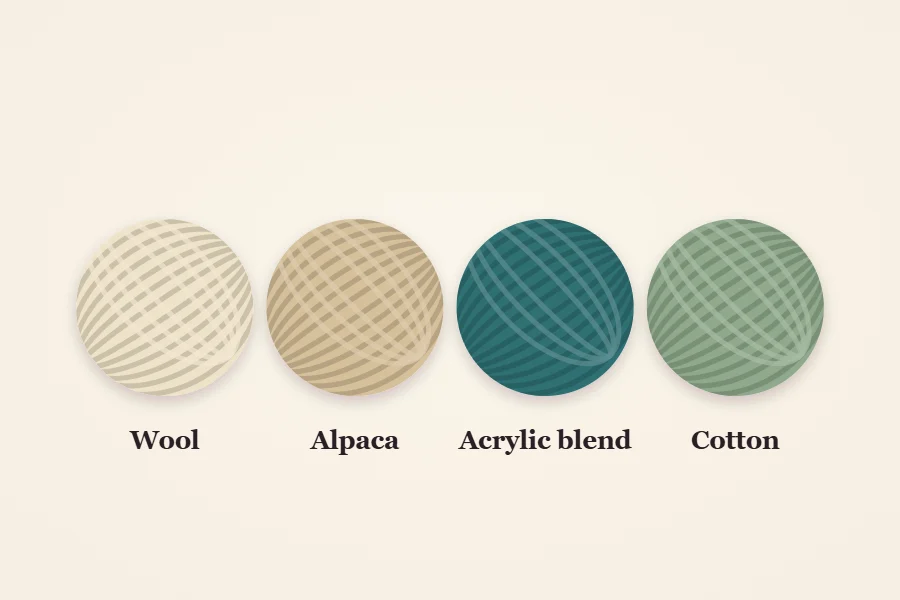
| Fiber | Warmth | Against the neck | Care |
|---|---|---|---|
| Wool (including merino) | High; springy and stays warm when damp | Ranges from soft to scratchy depending on the wool | Hand wash cool unless labeled superwash |
| Alpaca | Very high; often warmer than wool for the same thickness | Soft and silky, with a slight fuzzy halo | Hand wash cool; dry flat because it stretches |
| Wool-acrylic or other blends | Medium to high, depending on the wool content | Usually soft | Often machine washable; check the label |
| Acrylic | Medium; warm when dry, less so when damp | Soft, no wool itch | Machine washable; keep away from high heat |
| Cotton | Low; holds moisture and feels cold | Smooth and cool | Machine washable |
For a scarf meant for real cold, wool, alpaca or a blend with a good share of either is the practical choice. Cotton is better kept for mild weather. The full fiber comparison, including how each one shows stitches, is in the best yarn for scarves.
Thick fabrics that trap air
The same yarn can make a thin fabric or a lofty one, depending on the stitch pattern.
- Garter stitch (knit every row) is thicker than it looks. The ridges stand up on both sides, so the fabric is noticeably deeper than plain stockinette and holds air in every furrow.
- Ribbing pulls in, so more stitches are packed into every inch of width and the columns form deep channels. A 2×2 ribbed scarf is dense, elastic and hugs the neck, which stops drafts.
- Mistake rib and other deep textures behave like rib, with even more loft.
- Thicker yarn gives a thicker fabric with no extra effort. A chunky knit scarf in super bulky yarn is warm almost regardless of stitch.
- Doubled fabric is the warmest option: a wide scarf folded in half lengthwise and seamed, or two strands of yarn held together. Two layers trap a third layer of air between them.
For winter, knit at the needle size on the label or one size up at most. Much larger needles give a loose, open fabric that looks soft but lets the wind straight through. Stockinette on its own is thin and curls at the edges, so it is a poor choice unless you knit it as a doubled tube.
Tip
Hold a swatch up to a window. If you can see clear daylight between the stitches, wind will get through too. Go down a needle size or pick a denser stitch.
Width and length for wrapping
A typical adult scarf is 6 to 8 in (15 to 20 cm) wide and 60 to 70 in (150 to 180 cm) long. A winter scarf earns its keep at the top of those ranges or beyond them: 8 to 10 in (20 to 25 cm) wide, so it covers the neck from collar to chin, and 70 to 80 in (180 to 200 cm) long, so it goes around twice and still leaves ends to tuck inside a coat. More styles and measurements are in the scarf width and length guide.
Keep in mind that thick fabric is bulky. A 10 in wide scarf in super bulky yarn wrapped twice can be too much under a fitted collar. With very thick yarn, stay near 7 to 8 in wide and put the extra into length. Rib also measures narrower when relaxed than when you spread it flat, so judge the width of a ribbed scarf as it will be worn.
Budget for more yarn
A bigger, denser scarf needs noticeably more yarn than a standard one. The arithmetic is simple: a 7 x 65 in scarf has an area of 455 square inches, and a 9 x 75 in scarf has 675 square inches, which is about 1.5 times as much fabric.
A standard garter scarf in worsted-weight (#4) yarn takes roughly 250 to 350 yd (230 to 320 m). Multiply by 1.5 and the winter-sized version comes to roughly 375 to 525 yd (345 to 480 m), still in garter. Rib and deep textures use more again, because they pack extra stitches into each inch. Holding two strands together doubles the yardage outright. Treat all of these as estimates and buy an extra skein from the same dye lot; the ways to tighten the estimate are in how much yarn for a scarf.
Itch and comfort
The skin on the neck and chin is sensitive, and a scarf sits there for hours. Warmth is no use if the scarf stays in a drawer because it prickles.
- Finer fibers feel softer. Merino wool and alpaca are generally gentler than coarse, rustic wools.
- Test before you commit: hold the ball against the side of your neck or under your chin for a minute. The back of your hand is a poor judge.
- If the scarf is a gift and you do not know how the wearer reacts to wool, a soft wool-acrylic blend or a good acrylic is the safer pick.
- Fuzzy yarns with a halo are warm, but loose fibers can tickle the nose and shed on dark coats.
- Very heavy scarves pull on the neck. Alpaca and cotton are dense fibers; a blend with wool keeps the weight down.
Care that keeps the warmth
Loft is what makes a scarf warm, and careless washing destroys loft.
- Non-superwash wool and alpaca felt when they meet heat, soap and agitation together. Wash by hand in cool water, squeeze without wringing, and dry flat.
- Superwash wool can usually go in the machine on a gentle cycle, but it tends to grow when wet. Lay it flat and pat it back to size.
- Acrylic and acrylic blends are easy to wash but should stay away from a hot dryer and never meet an iron.
Watch out
Do not hang a wet scarf to dry. Water makes it heavy, and a long, thick scarf can stretch by several inches and come out thinner. Dry it flat on a towel instead.
A sensible plan to start from
If you want one reliable recipe: choose a soft wool or wool-blend yarn in worsted or bulky weight, knit it in garter stitch or 2×2 rib at the needle size on the label, make it 8 to 9 in (20 to 23 cm) wide and at least 70 in (180 cm) long, and buy one skein more than the estimate. That combination is warm, reversible, lies flat and is well within reach of a newer knitter.
Frequently asked questions
What is the warmest yarn for a scarf?
Wool and alpaca are the warmest common choices because their fibers trap air and stay fairly warm when damp. A blend with a good share of either is nearly as warm and often easier to wash.
Is an acrylic scarf warm enough for winter?
For everyday cold, yes, especially in a thick yarn and a dense stitch such as garter or rib. It is less warm than wool once it gets damp, so wool or a wool blend is the better choice for long spells outdoors.
How long should a winter scarf be?
About 70 to 80 in (180 to 200 cm) lets most adults wrap the scarf around the neck twice and still tuck in the ends. A standard 60 to 70 in (150 to 180 cm) scarf works if you prefer a single wrap.