How to Add Fringe to a Scarf: Yarn Amounts, Knots and Trimming
Fringe is cut strands knotted through the ends of a finished scarf. Work out the yarn first: 12 three-strand tassels per end with a 5 in fringe take about 22 yd.
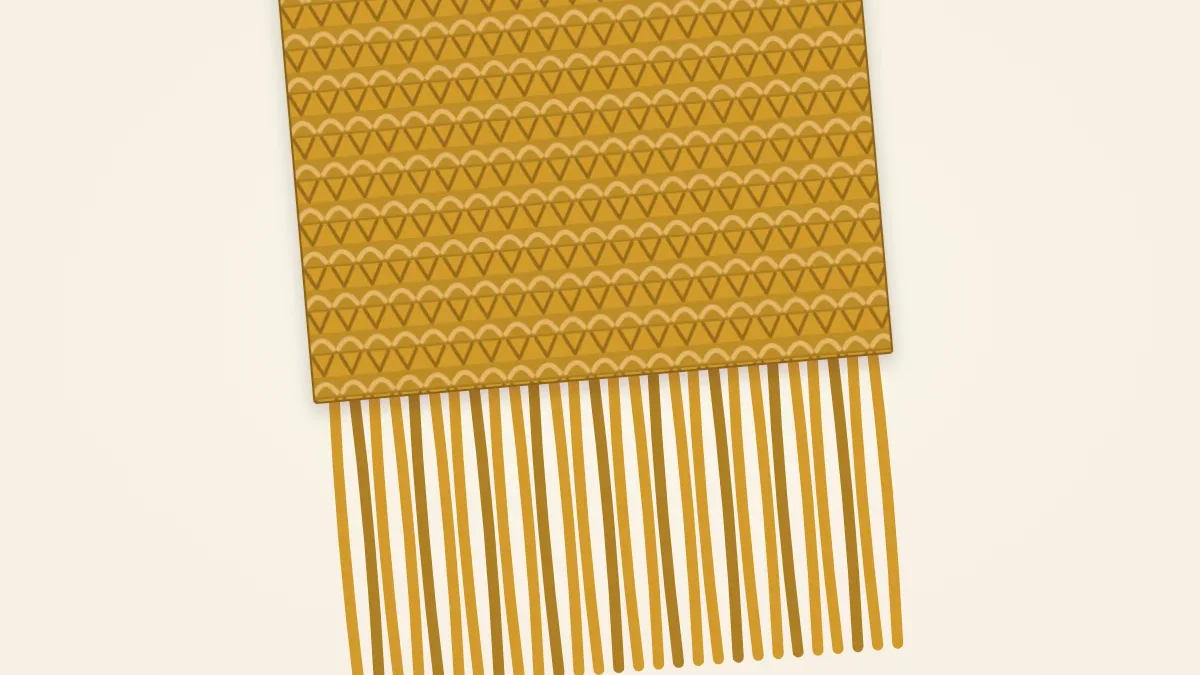
Fringe is made after the knitting is finished: you cut a batch of equal strands, fold them in small groups, and knot each group through the cast-on or bind-off edge with a crochet hook. The knot is simple. The parts that go wrong are the planning ones, usually running out of yarn or ending up with strands of different lengths, so start with the numbers.
How much yarn fringe takes
Every strand is folded in half, so a cut strand has to be twice the finished fringe length, plus about 1 in (2.5 cm) that disappears into the knot and the final trim.
- Cut length = (finished fringe length x 2) + 1 in
- Number of strands = tassels per end x strands per tassel x 2 ends
- Yarn needed = number of strands x cut length
Here is that arithmetic for two typical scarves.
| Worsted scarf, 7 in (18 cm) wide | Super bulky scarf, 7 in (18 cm) wide | |
|---|---|---|
| Finished fringe length | 5 in (13 cm) | 6 in (15 cm) |
| Cut length per strand | 11 in (28 cm) | 13 in (33 cm) |
| Tassels per end | 12 | 8 |
| Strands per tassel | 3 | 2 |
| Total strands, both ends | 72 | 32 |
| Yarn needed | 792 in = 22 yd (about 20 m) | 416 in = about 11.5 yd (10.5 m) |
Round up by a few yards for strands you cut badly. Then set the fringe yarn aside before you knit the scarf, or at least before the last ball runs low. The yardage ranges in how much yarn for a scarf cover the knitting only, so fringe is always extra. If you are working a one-skein scarf and knitting until the yarn runs out, measure off the fringe yarn first and wind it into its own small ball.
What you need
- The same yarn as the scarf, or a contrasting color in the same weight
- A piece of stiff cardboard or a hardcover book
- Sharp scissors
- A crochet hook large enough to catch all the strands of a tassel at once; for worsted yarn, something around US H-8 (5 mm) or larger
- A ruler or tape measure
Cut equal strands around cardboard
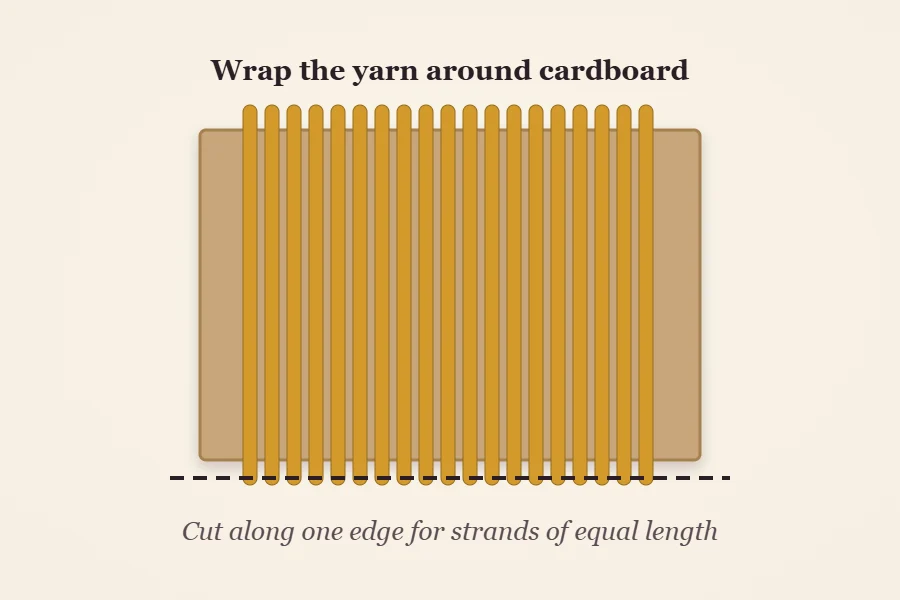
Measuring and cutting 72 strands one at a time is slow and never quite even. Wrapping is faster. Cut a piece of cardboard whose width is half the cut length: 5.5 in (14 cm) for 11 in strands, 6.5 in (16.5 cm) for 13 in strands. One full wrap around the card then uses exactly one strand’s worth of yarn.
- Hold the yarn end at one edge of the card and wrap the yarn around it, side by side, without pulling. Yarn wrapped under tension springs back shorter once it is cut.
- Count the wraps: one wrap makes one strand. Wrap in batches of 20 or 30 so the layers do not pile up and lengthen the outer strands.
- Slide the scissors under the wraps along one edge only and cut straight across.
- Lift the strands off and keep them flat and straight.
Plan the spacing
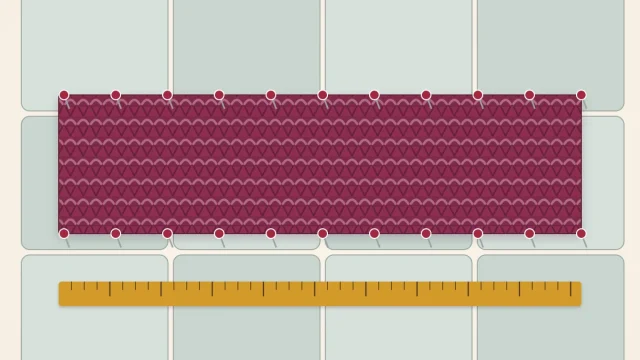
Lay the scarf end flat and decide where the tassels go before you attach any. Put one tassel in each corner stitch so the fringe runs the full width, then divide the space between them. Twelve tassels across a 7 in end leave 11 gaps, so the knots sit roughly 5/8 in (1.6 cm) apart; in worsted garter that is about every second or third stitch. Thicker yarn needs fewer, wider-spaced tassels.
Count stitches rather than measuring with a ruler, and mark the positions with pins or scraps of contrasting yarn if it helps. If the count does not divide evenly, put the odd-sized gaps in the middle, where they are least visible. Make both ends match.
Attach each tassel with a lark’s head knot
Work with the same side of the scarf facing you for every knot, on both ends, so all the knots look alike.
- Take the strands for one tassel, line up their ends and fold the group in half.
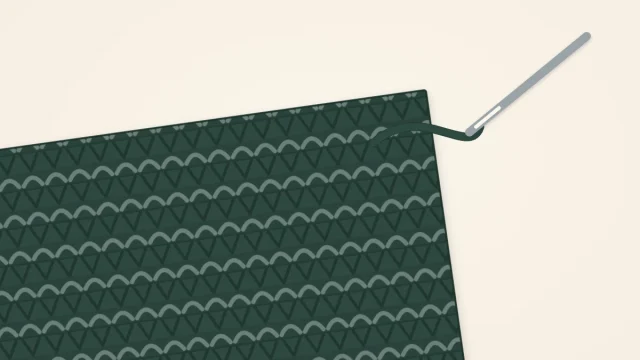
- Push the crochet hook through the edge of the scarf from back to front, under both strands of the edge stitch, catch the folded loop and pull it partway through to the back.
- Remove the hook and pass all the cut tails through the loop.
- Pull the tails gently until the knot sits snug against the edge. Tighten each knot by the same amount.
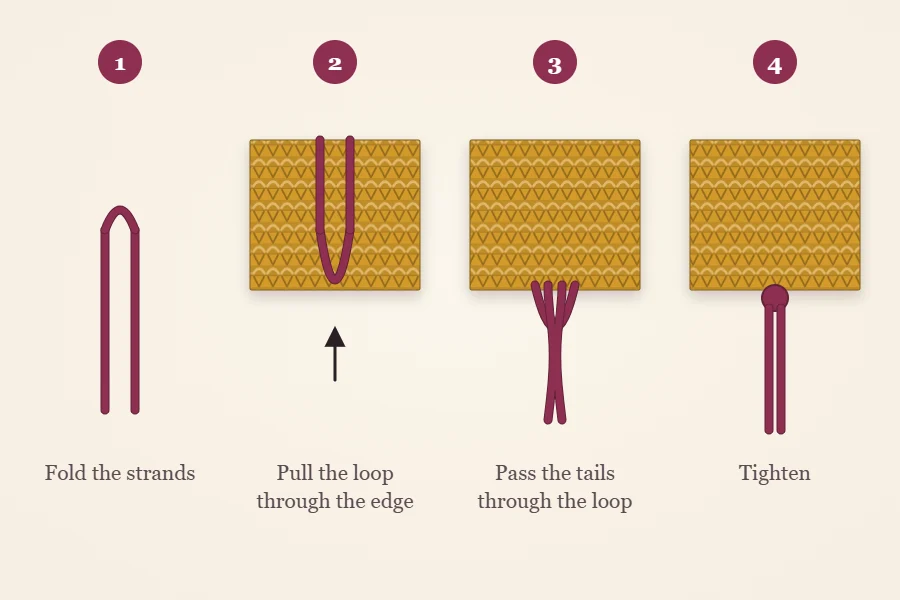
Going under both strands of the edge stitch matters. A knot hung from a single strand drags that strand into a long loop over time. Do not overtighten either: knots pulled hard make the end of the scarf flare or pucker.
Tip
Attach the two corner tassels and the middle one first, then fill in between them. It is much easier to keep the spacing even that way than by working from one side to the other.
Trim the fringe level
Freshly knotted fringe is always a little ragged, which is why the cut length includes extra. Lay the scarf end on a table, comb the strands straight with your fingers, and place a ruler or the edge of a book across them at the finished length. Cut along that line with sharp scissors, a few strands at a time. Small snips are safer than one long cut, because yarn shifts under the blades.
Kinked strands, common with yarn that was wound tightly, relax if you dampen them and let them dry straight. If you plan to block the scarf, do it before adding the fringe or keep the fringe out of the way; the fiber rules in how to block a knitted scarf apply to the fringe as well, and acrylic fringe should never touch an iron.
When fringe is a bad idea
- Scarves for babies and small children. Strands can be pulled loose and end up in a mouth. Leave these plain.
- Loosely spun single-ply yarn. A cut end of roving-style yarn untwists, fluffs and mats with wear. Plied yarn holds a clean end far better; the constructions are compared in choosing super bulky yarn for scarves.
- Scarves that go through the washing machine often. Fringe tangles and frays faster than the knitted fabric. Wash it in a mesh bag or skip the fringe.
- When yarn is tight. Those 22 yd could be several more inches of scarf.
- Loops. An infinity scarf has no free ends to finish.
Watch out
Fringe adds to the overall length. Two 5 in (13 cm) fringes make a 60 in (152 cm) scarf hang like a 70 in (178 cm) one, so decide on fringe before you decide when to bind off.
Frequently asked questions
How long should scarf fringe be?
A finished length of 4 to 6 in (10 to 15 cm) suits most adult scarves. Cut each strand twice that length plus about 1 in (2.5 cm) to allow for the knot and the final trim.
Can I add fringe without a crochet hook?
Yes. Thread the folded loop through the edge with a tapestry needle, or push it through with your fingers if the stitches are large. A crochet hook is simply faster and easier on the edge stitches.
How many strands go in each fringe tassel?
Two to four strands is typical. Use more strands with thinner yarn and fewer with bulky yarn, and keep the number the same in every tassel so the fringe looks even.