Infinity Scarf for Beginners: Knit Flat and Seamed Into a Loop
A beginner infinity scarf knit flat as a garter stitch rectangle and seamed into a loop, with numbers for a single loop or a double loop and an optional half twist.
Tutorial at a glance
Materials
- Tapestry needle
- Scissors
- Tape measure
- Locking stitch markers or safety pins
An infinity scarf does not have to be knit in the round. The simplest version is an ordinary flat rectangle, knit back and forth exactly like a first scarf, with its two short ends sewn together at the finish. If you can cast on, knit and bind off, you already have every skill this project needs except the seam, and the seam is short.
How the construction works
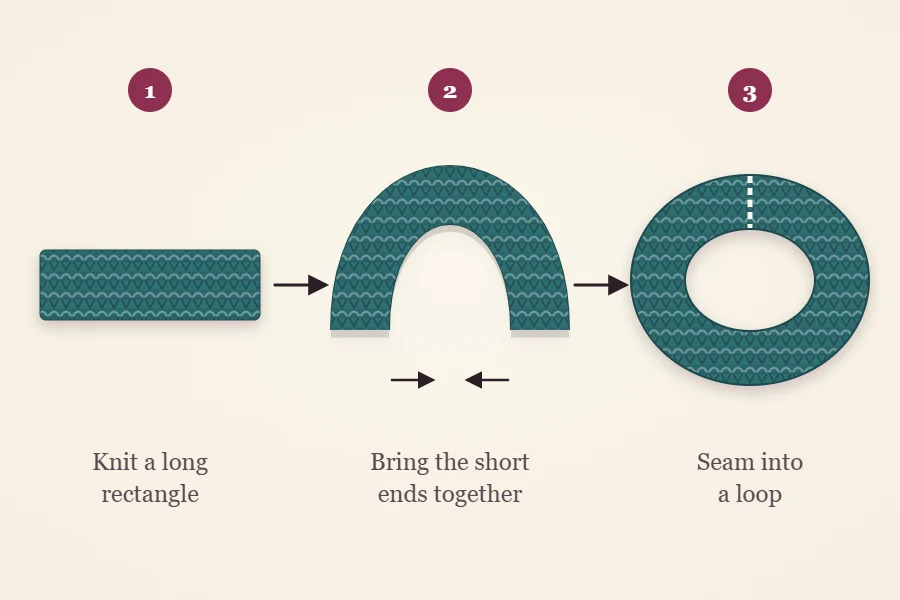
- Knit a long rectangle. Its length becomes the circumference of the loop.
- Fold it so the cast-on edge meets the bind-off edge.
- Sew those two edges together.
Because the loop has no loose ends, you can make it shorter than a regular scarf and still have it stay put. That also means less knitting.
Single loop or double loop
Decide the length before you cast on, because it sets how much yarn you need.
| Style | Circumference to knit | How it wears | Estimated yarn (worsted, 8 in wide, garter) |
|---|---|---|---|
| Single loop | About 28 in (71 cm) | Sits once around the neck, like a cowl | Roughly 125-170 yd (115-155 m) |
| Double loop | About 55 in (140 cm) | Hangs long, or wraps twice for warmth | Roughly 250-340 yd (230-310 m) |
These are example values from the usual ranges: about 26-32 in (66-81 cm) for a single loop and 50-60 in (127-152 cm) for one that wraps twice. The infinity scarf size guide explains how to pick a number inside those ranges and how to check it with a piece of string. The yardage figures are estimates scaled from a typical adult scarf; buy with a margin.
Materials
- Yarn: worsted weight (#4) in a light or medium solid color, in the amount shown in the table for your chosen size.
- Needles: US 8 (5 mm) straight needles, or a circular needle used flat.
- Notions: tapestry needle, scissors, tape measure and two or three locking stitch markers or safety pins for holding the ends together before seaming.
A soft yarn matters more here than in a long scarf, since the whole loop sits against your neck. If you are unsure what to buy, the yarn guide compares the common fibers.
The pattern
Abbreviations: CO (cast on), BO (bind off), k (knit), st(s) (stitch or stitches), sl (slip), wyif (with yarn in front).
Typical gauge is about 4.5 sts per inch in garter stitch, which makes 36 stitches come out at 8 in (20 cm) wide: 36 divided by 4.5 is 8. Garter works on any number of stitches, so matching the gauge exactly is not important. If your fabric is a little wider or narrower, the scarf still works.
- CO 36 sts, leaving a tail of about 24 in (60 cm). You can use this tail for the seam later, which saves weaving in two extra ends.
- Knit every stitch of every row. This is garter stitch: two rows make one ridge, the fabric lies flat and it looks the same on both sides.
- Continue until the piece measures 28 in (71 cm) for a single loop or 55 in (140 cm) for a double loop. Lay it flat on a table and measure without stretching.
- BO all sts loosely. Before you begin, check that you have a strand at least four times the width of the scarf, about 32 in (81 cm). Cut the yarn, leaving at least 6 in (15 cm), and pull it through the last stitch.
Optional neat edge
For tidier long edges, start every row this way: sl the first stitch purlwise wyif, move the yarn to the back between the needles, then knit to the end. The guide to neat scarf edges shows what the result looks like. Use it on every row or not at all; mixing the two leaves a visible change.
Tip
Count your stitches every few inches. It should always be 36. A loop that is wider at one end than the other will not line up at the seam.
Other stitches that work
Any stitch that lies flat and looks good on both sides suits a loop, because the inside shows when the scarf folds over on itself. Plain stockinette curls and is best avoided.
| Stitch | Stitch count needed | Cast on for this scarf | How to work it |
|---|---|---|---|
| Garter | Any number | 36 | Knit every row |
| Seed stitch | Odd number | 35 | Every row: k1, *p1, k1; repeat from * to end |
| Mistake rib | Multiple of 4 plus 3 | 39 | Every row: *k2, p2; repeat from * to last 3 sts, k2, p1 |
In the table, p means purl. The counts check out: 35 is odd, and 39 is 4 times 9 plus 3. Mistake rib pulls in, which is why it takes a few more stitches to reach a similar width, and it uses more yarn than garter.
The optional half twist
Before seaming, you can flip one short end over once so the loop has a permanent half twist in it. The twist helps the fabric fold neatly when you double the scarf around your neck and gives the loop its familiar draped look. A plain, untwisted loop is equally correct and lies flatter, which suits a short single loop.
A half twist means one end is joined face down against the other, so the “back” of the fabric becomes visible along part of the loop. With garter, seed stitch or mistake rib that makes no difference. It is one more reason to choose a stitch that looks good on both sides.
Seaming and finishing
Lay the rectangle flat, add the half twist if you want one, and bring the cast-on and bind-off edges together. Pin them with locking markers and try the loop on over your head. Check the length and the twist now; both are awkward to change once the seam is sewn.
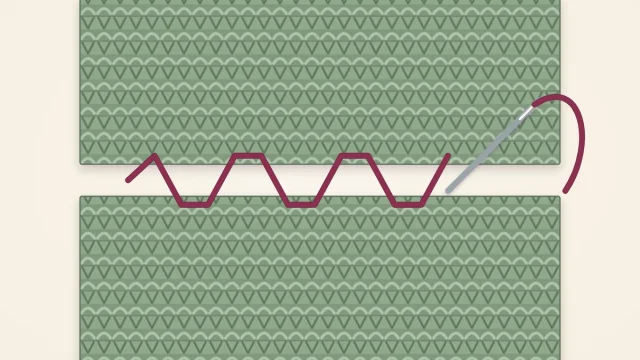
Thread the long tail onto the tapestry needle and sew the edges together, matching stitch to stitch. The step-by-step method, including a nearly invisible seam for garter stitch, is in how to join an infinity scarf. Then weave in the remaining ends along a garter ridge and trim them.
Watch out
Garter stitch stretches lengthwise as it is worn. If you are between two lengths, choose the shorter one.
Frequently asked questions
Can I knit an infinity scarf on straight needles?
Yes. Knit a flat rectangle on straight needles and sew the cast-on edge to the bind-off edge to make the loop. No circular knitting is needed.
How long should I knit an infinity scarf before joining it?
About 26-32 in (66-81 cm) for a single loop and about 50-60 in (127-152 cm) for a loop that wraps twice. This pattern uses 28 in and 55 in as examples.
Does an infinity scarf need a twist?
No. A half twist helps the scarf drape and fold when doubled, but a plain loop works just as well. If you add a twist, use a stitch that looks good on both sides.