Infinity Scarf Size Guide: Circumference and Width for Every Wrap
Typical infinity scarf circumferences for a single loop, double wrap and triple wrap, the widths that suit each, and how to measure with a string before you knit.
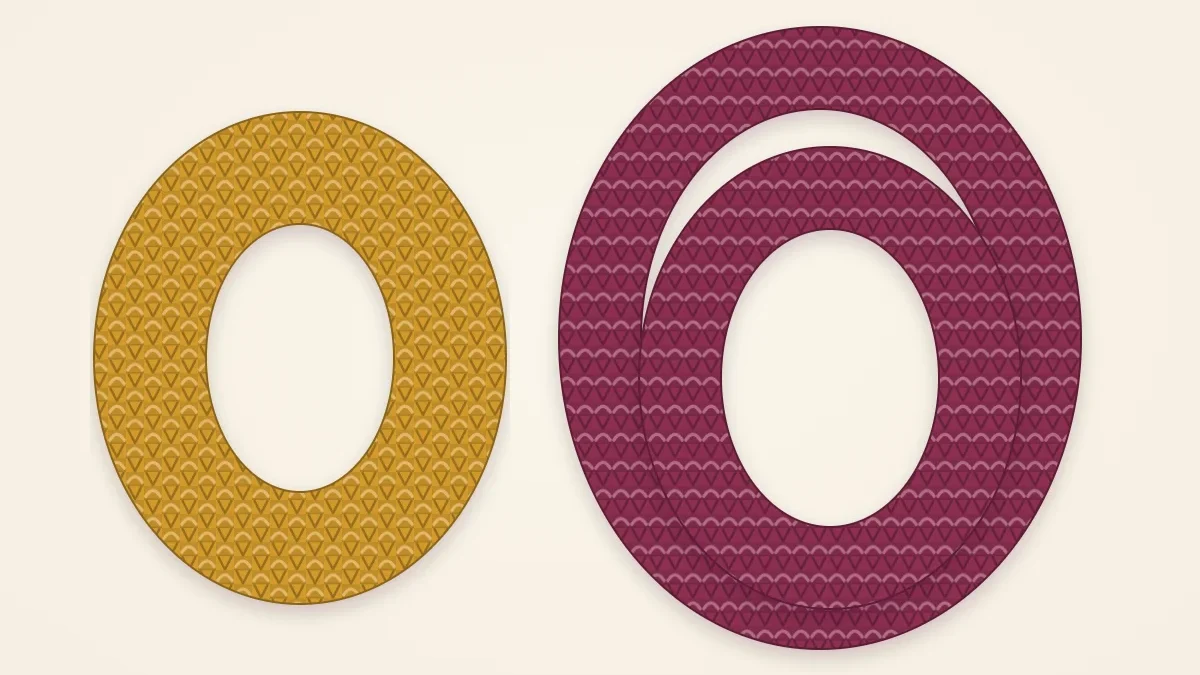
With an infinity scarf, one number does most of the work: the circumference of the loop. It decides whether the scarf sits once around the neck, wraps twice or wraps three times, and it cannot be adjusted after the ends are joined. Width matters too, but less, and stretch quietly changes both.
Circumference by number of wraps
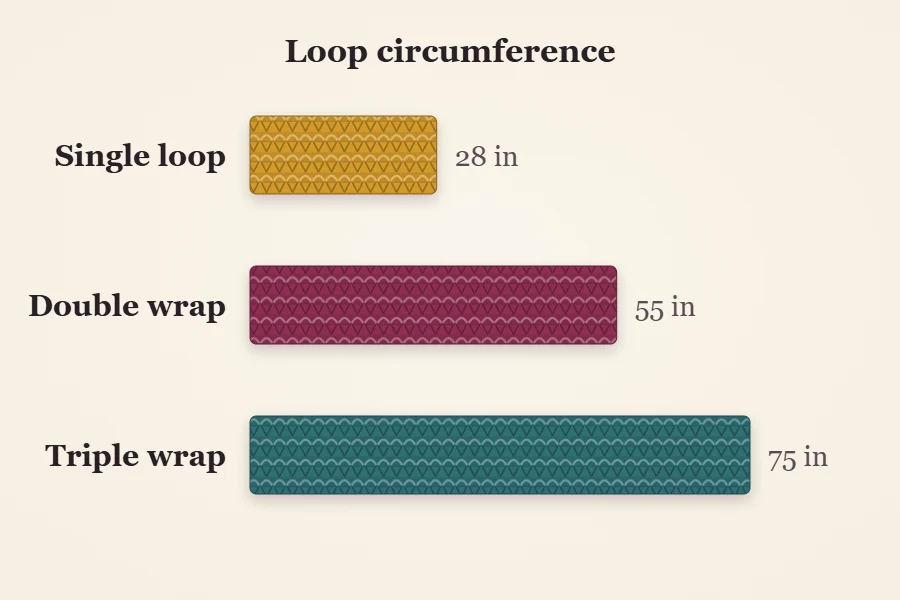
The diagram shows one common value for each style. Each sits inside a range, and where you land in that range depends on the wearer and on how close to the neck you want the scarf.
| Style | Typical range | Example | How it wears |
|---|---|---|---|
| Single loop | 26-32 in (66-81 cm) | 28 in (71 cm) | Once around the neck, like a cowl |
| Double wrap | 50-60 in (127-152 cm) | 55 in (140 cm) | Worn long, or wrapped twice |
| Triple wrap | About 70-80 in (178-203 cm) | 75 in (190 cm) | Worn long, doubled, or wrapped three times for full coverage |
Single loop
The loop has to pass over the head, so it cannot be much smaller than about 26 in (66 cm) unless the fabric is very stretchy. At the short end of the range it sits close and warm; toward 32 in (81 cm) it hangs lower and looser. A single loop is the fastest to knit and uses the least yarn.
Double wrap
This is the size most people picture. Around 50 in (127 cm) gives two snug wraps; around 60 in (152 cm) gives two relaxed ones, with the lower loop resting on the chest. The 55 in example works out to two wraps of about 27.5 in each.
Triple wrap
A long loop gives the most ways to wear it, but three layers of fabric add up. At 75 in, three wraps are about 25 in each, so the fabric needs some stretch and should not be too thick. Lighter yarn and a narrower width keep it comfortable.
Choosing the width
On a loop, the width of the knitted strip becomes the height of the scarf on the neck. The more times the scarf wraps, the narrower it should be, because the layers stack.
| Style | Typical width | Why |
|---|---|---|
| Single loop | 8-12 in (20-30 cm) | One layer has to do all the covering; it scrunches down to fit |
| Double wrap | 6-10 in (15-25 cm) | Two layers; close to an ordinary scarf width |
| Triple wrap | 5-7 in (13-18 cm) | Three layers; narrower keeps the bulk down |
These are typical choices, not rules. Thick yarn pushes you toward the narrow end of each range and fine yarn toward the wide end. For regular scarves, the scarf width and length guide covers the same decisions.
Measure with a string before you knit
A piece of string settles the question faster than any chart, especially when the scarf is for a child or you want a particular fit.
- Take a length of non-stretchy string or yarn, longer than you think you need.
- Loop it around your neck the number of times you want the scarf to wrap, and let each loop hang where you would like the scarf to sit.
- Pinch the string where it meets its own end, take it off and measure it flat against a tape measure.
- For a single loop, check that the string still passes comfortably over the head.
- Write the number down. That is your target circumference.
Tip
A string is thin and a scarf is not. For a thick, wide scarf, add an inch or two to the string measurement so the layers have room to sit side by side.
How stretch changes the numbers
Knitted fabric does not stay the length it was on the needles. What it does depends on the stitch, the fiber and the direction you knit.
- Garter stitch stretches lengthwise under its own weight. A long garter loop knit flat and seamed usually ends up somewhat longer in wear than it measured on the table.
- Rib pulls in across its width and springs back, so it hugs the neck. Measure it relaxed, not stretched.
- Heavy and inelastic fibers such as alpaca, cotton and superwash wool tend to grow. Springy non-superwash wool holds its size better.
- Blocking can add length to wool. Acrylic does not hold a wet block, so it stays close to its knitted size.
The practical rule: if you are choosing between two lengths in a stretchy stitch or a heavy fiber, knit the shorter one. A loop that is a little short still wraps; one that has grown too long hangs loose and lets cold air in.
Watch out
Measure the piece lying flat on a table, never hanging from the needles. The weight of the hanging fabric stretches it and gives a reading that is too long.
Turning a size into stitches
How the measurements become stitch counts depends on the construction.
- Knit flat and seamed: the cast-on sets the width, and you knit until the length equals the circumference. At a typical worsted gauge of 4.5 stitches per inch, an 8 in width needs 8 times 4.5, or 36 stitches. You then knit to 28 in or 55 in and join the ends.
- Knit in the round: the cast-on sets the circumference and you knit until the tube is as tall as the width you want. At the same gauge, a 28 in single loop needs 28 times 4.5, or 126 stitches.
Use your own gauge in place of the 4.5; the gauge swatch guide shows how to measure it. For a first loop the flat method is simpler, and the beginner infinity scarf pattern walks through it with these same numbers. The flat method also lets you try the length on before committing: pin the ends, put it over your head, and only then follow the steps in joining an infinity scarf.
Sizes for children
Children need shorter loops, and the string method matters more because sizes vary so much with age. As a starting point, a single loop for a child is usually a few inches shorter than an adult one while still passing easily over the head, and a narrower width of 4-6 in (10-15 cm) keeps the scarf from covering the chin and mouth.
Long double and triple loops are not a good choice for young children. A close-fitting single loop that pulls off easily is the safer design.
Quick reference
- Single loop: 26-32 in (66-81 cm) around, 8-12 in (20-30 cm) wide.
- Double wrap: 50-60 in (127-152 cm) around, 6-10 in (15-25 cm) wide.
- Triple wrap: about 70-80 in (178-203 cm) around, 5-7 in (13-18 cm) wide.
- Stretchy stitch or heavy fiber: choose the shorter end of the range.
- Unsure: measure with a string, then pin and try on before joining.
Frequently asked questions
How long should an infinity scarf be to wrap twice?
About 50-60 in (127-152 cm) in circumference. Around 55 in (140 cm) is a common middle value that gives two comfortable wraps.
How wide should an infinity scarf be?
Typically 8-12 in (20-30 cm) for a single loop, 6-10 in (15-25 cm) for a double wrap and 5-7 in (13-18 cm) for a triple wrap. The more layers, the narrower the strip can be.
Will my infinity scarf stretch after I finish it?
Often a little, especially in garter stitch or in heavy fibers such as alpaca, cotton and superwash wool. If you are between two lengths, knit the shorter one.