Lightweight Spring Scarf: An Easy Knitting Pattern in DK Yarn
An airy garter scarf for spring and fall, knit in DK-weight cotton, linen or a wool blend on US 8 (5 mm) needles. Cast on 36 stitches for a scarf about 8 x 64 in.
Tutorial at a glance
Materials
- Tapestry needle
- Scissors
- Tape measure
A scarf for spring or fall has a different job from a winter one. It only needs to take the edge off a cool morning, and it has to be comfortable when the afternoon warms up. Two choices get you there: a thinner yarn in a fiber that breathes, and needles larger than the yarn label suggests, so the stitches open up and the fabric hangs instead of standing stiff. The pattern below uses DK-weight yarn, nothing but the knit stitch, and makes a scarf about 8 in (20 cm) wide and 64 in (163 cm) long.
Choose a fiber that breathes
For mild weather, look at plant fibers and blends before pure wool. A smooth, plied yarn in a light or medium solid color shows the open stitches best; the wider fiber comparison is in the best yarn for scarves.
| Fiber | How it behaves in a light scarf | Keep in mind |
|---|---|---|
| Cotton | Cool, smooth and easy to wash | No stretch, heavier than wool, can grow in length with wear |
| Linen and linen blends | Crisp at first, softer with every wash, very airy | Feels stiff on the needles and shows uneven tension |
| Cotton-wool or cotton-acrylic blends | Lighter and springier than pure cotton | Check the label for the care of the most delicate fiber |
| Fine wool or wool-silk blends | Light, elastic, warm for its weight | Better for early spring and fall than for warm days |
Because cotton and linen have no elasticity, they are less forgiving of tight knitting than wool. Keep your hands relaxed and let the larger needles set the stitch size.
Why larger needles make the fabric drape
DK yarn (#3 on the Craft Yarn Council scale) is usually knit on US 5 to 7 (3.75 to 4.5 mm) needles. That range gives a firm, even fabric, which is right for a sweater and too dense for a breezy scarf. Going up to US 8 (5 mm) makes each stitch bigger while the strand stays the same thickness, so there is more air between the strands. The fabric becomes lighter per inch, more flexible, and it uses less yarn for the same area. The general logic for any yarn weight is in the guide to needle size for scarves.
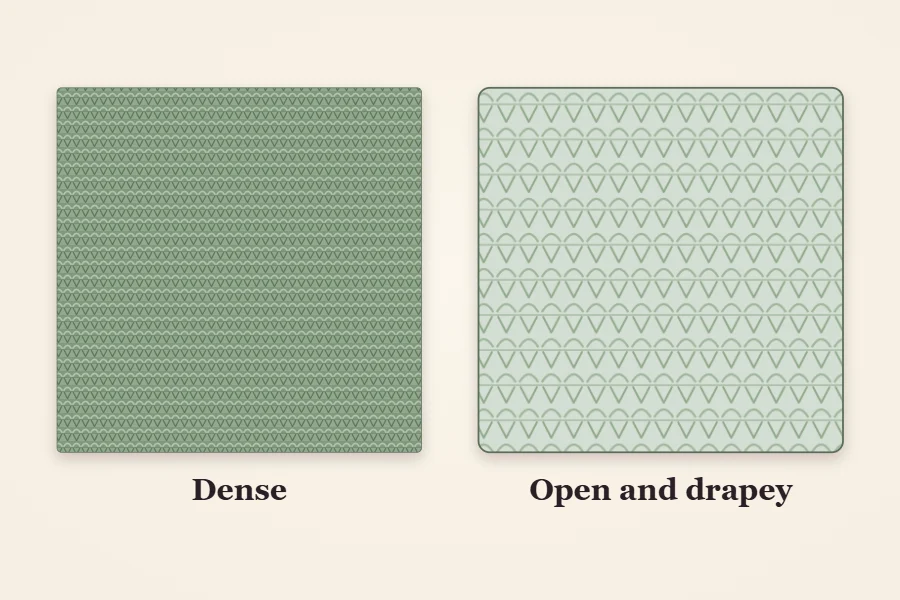
There is a limit. If the needles are too large, the stitches turn sloppy and snag on everything. If a swatch looks like netting, go down one size.
What you need
- DK-weight (#3) yarn in cotton, linen or a wool blend: roughly 300 to 380 yd (275 to 350 m). This is an estimate, so buy about 400 yd (365 m) to be safe.
- US 8 (5 mm) needles, straight or circular used flat. Wood or bamboo grips slippery cotton better than metal.
- Tapestry needle, scissors and a tape measure
Gauge and finished size
Gauge for this scarf is about 18 stitches to 4 in (10 cm) in garter stitch, which is 4.5 stitches per inch. The width follows from that: 8 in x 4.5 stitches per inch = 36 stitches.
A scarf does not have to match gauge exactly, but with a loose fabric it is worth ten minutes to knit a small square, wash it the way you will wash the scarf, and measure it once dry. Plant fibers often relax after the first wash. If you count fewer than 4.5 stitches per inch, your scarf will come out wider and use more yarn; with more stitches per inch it will be narrower. The method is in how to swatch for a scarf.
The pattern
Abbreviations: CO (cast on), k (knit), sl (slip), st(s) (stitch or stitches), wyif (with yarn in front), BO (bind off).
- CO 36 sts loosely. A tight cast-on puckers the end of an open fabric; if yours tends to be tight, cast on over a needle one or two sizes larger, then switch to the US 8 (5 mm).
- Every row: sl 1 purlwise wyif, move the yarn to the back between the needles, k to the end of the row. You should have 36 sts at the end of every row.
- Repeat that row until the scarf measures 64 in (163 cm), or until you have about 32 in (81 cm) of yarn left, which is four times the scarf width and enough to bind off.
- BO all sts loosely. Cut the yarn, leaving a 6 in (15 cm) tail, and pull it through the last st.
This is garter stitch: knit every row, with two rows making one ridge. It lies flat, looks the same on both sides, and on large needles it turns from a dense, bumpy fabric into a soft, open one. The slipped first stitch gives each side a tidy chain edge.
At a typical 8 to 9 rows per inch, 64 in works out to somewhere between 512 and 576 rows, or 256 to 288 ridges. Treat that as a rough guide and measure with the tape, laying the scarf flat without stretching it.
Tip
Loose garter stitch lengthens under its own weight. Before you bind off, hold the scarf up by one end for a moment, then lay it flat and measure again. If it has grown past your target length, you can stop a few rows earlier.
Change the width or add texture
To resize the scarf, multiply the width you want by 4.5 and round to a whole number. Yardage scales with the width.
| Width | Cast on (garter) | Cast on (seed stitch) | Estimated yarn for 64 in |
|---|---|---|---|
| 6 in (15 cm) | 27 sts | 27 sts | 225 to 285 yd (205 to 260 m) |
| 8 in (20 cm) | 36 sts | 37 sts | 300 to 380 yd (275 to 350 m) |
| 10 in (25 cm) | 45 sts | 45 sts | 375 to 475 yd (345 to 435 m) |
For a pebbly texture, work seed stitch instead. It needs an odd number of stitches, which is why the middle row of the table says 37. With p meaning purl, every row is: k1, *p1, k1*; repeat from * to the end. Seed stitch also lies flat and is reversible, though it is slower because the yarn moves between front and back on every stitch. There is a full walk-through in the seed stitch scarf pattern. Skip the slipped edge in seed stitch; the pattern makes its own neat border.
Finishing and care
Weave each tail along a garter ridge for a couple of inches and double back. Open fabric hides less than dense fabric, so follow the path of the stitches closely and leave the tails untrimmed until after the first wash.
Washing is what settles a cotton or linen scarf. Follow the yarn label; many cotton and linen yarns are machine washable on a gentle cycle, while wool blends usually want a cool hand wash. Squeeze out the water in a towel, lay the scarf flat, pat it to 8 in wide along its whole length and let it dry. Do not hang a wet plant-fiber scarf, because the weight of the water stretches it. Pins are rarely needed for garter stitch, but the fiber-by-fiber rules are in how to block a knitted scarf. Store the scarf folded or rolled, not on a hook, so it keeps its length from one season to the next.
Frequently asked questions
Can I use worsted-weight yarn for a spring scarf?
You can, but the scarf will be thicker and warmer. Choose a cotton or cotton-blend worsted, go up one or two needle sizes for drape, and recalculate the cast-on from your own gauge.
Is cotton yarn hard for beginners to knit with?
It is a little less forgiving than wool because it does not stretch, so uneven tension shows more. Wood or bamboo needles and a relaxed grip make it much easier to handle.
Will a loosely knit scarf stretch out of shape?
Open garter stitch can lengthen with wear, especially in cotton or linen. Washing it and drying it flat brings it back close to its original size, and storing it folded instead of hanging helps.