How to Join an Infinity Scarf: Seaming the Ends Into a Loop
How to join the two ends of a flat-knit infinity scarf with mattress stitch or whipstitch, decide on a twist, and check everything before you sew.
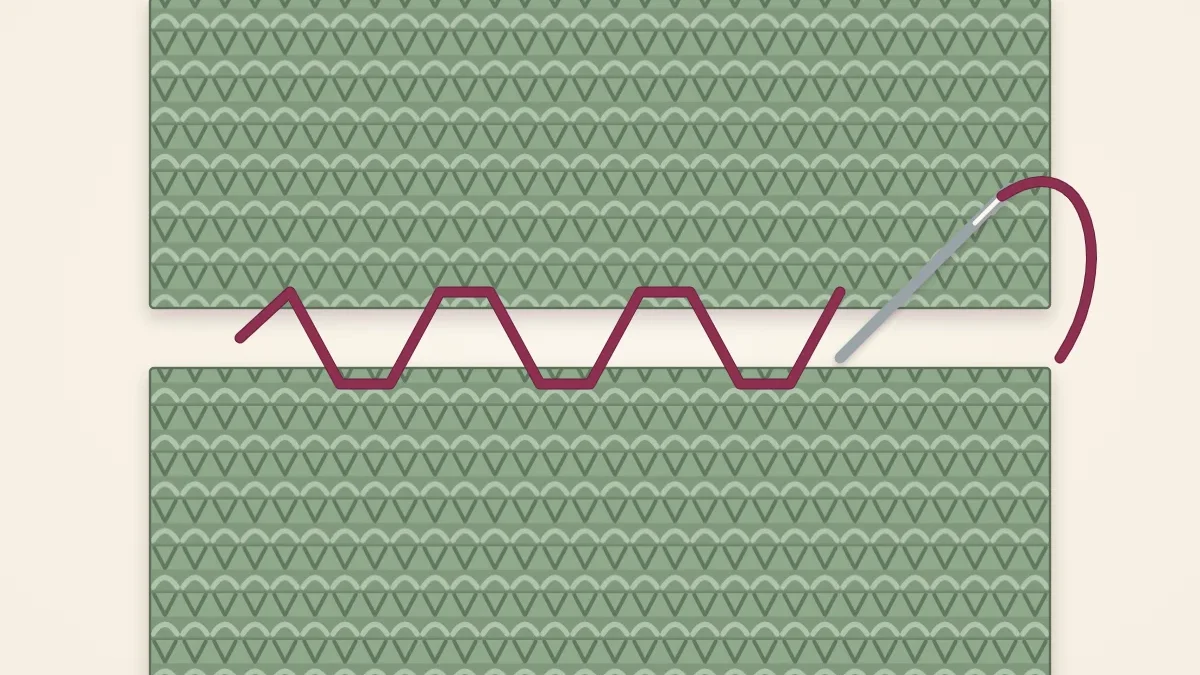
The join is the only part of a flat-knit infinity scarf that differs from an ordinary scarf, and it takes a few minutes. What decides whether it looks good is mostly what you do before the first stitch of the seam: checking the length, deciding on a twist and lining up the two edges stitch for stitch.
Check these things before you sew
- Stitch count. Both ends should have the same number of stitches. If the scarf grew or shrank along the way, the edges will not match, and it is better to know now.
- Length. Pin the ends together with locking stitch markers or safety pins and put the loop over your head. Wrap it the way you plan to wear it.
- Blocking. If you intend to block the scarf, do it while the piece is still flat. A straight rectangle is far easier to pin out than a loop. See how to block a knitted scarf for which fibers respond.
- Seaming yarn. You need a strand about three times the width of the scarf. A long cast-on or bind-off tail works; otherwise cut a new length of the same yarn.
If you have not knit the scarf yet, the beginner infinity scarf pattern gives the full numbers for the rectangle.
Twist or no twist
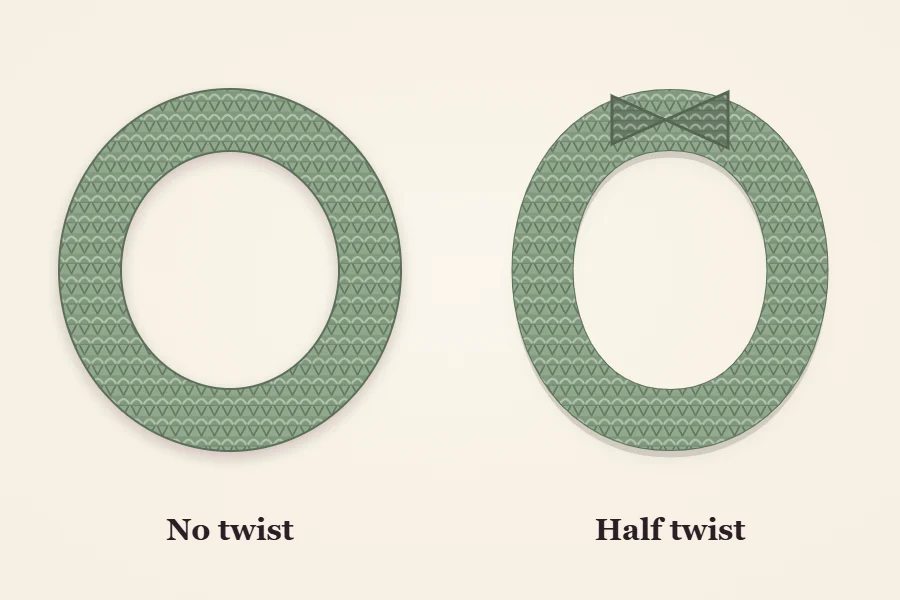
For a plain loop, lay the scarf flat with the same side facing up along its whole length and bring the ends together without turning either one. For a half twist, flip one end over once, so its underside faces up, then bring the ends together.
| No twist | Half twist | |
|---|---|---|
| How it sits | Flat, like a cowl or a headband | Folds over itself and drapes in a soft X when doubled |
| Best for | Short single loops | Long loops worn doubled |
| Stitch pattern | Any; one side can stay hidden | Reversible stitches, since both faces show |
The usual accident is the opposite problem: a twist nobody intended. A long strip of knitting turns over easily on a table. Run your hand along the full length from one end to the other and confirm the edge you are following stays on the same side the whole way. Then pin.
Watch out
One half twist is the limit. A full twist, where the end is turned over twice, makes the loop kink and it will never lie smoothly.
Seaming bound-off edges with mattress stitch
This is the method to learn first. It joins the cast-on edge to the bind-off edge from the outside of the work, so you can watch the seam form and correct it as you go.
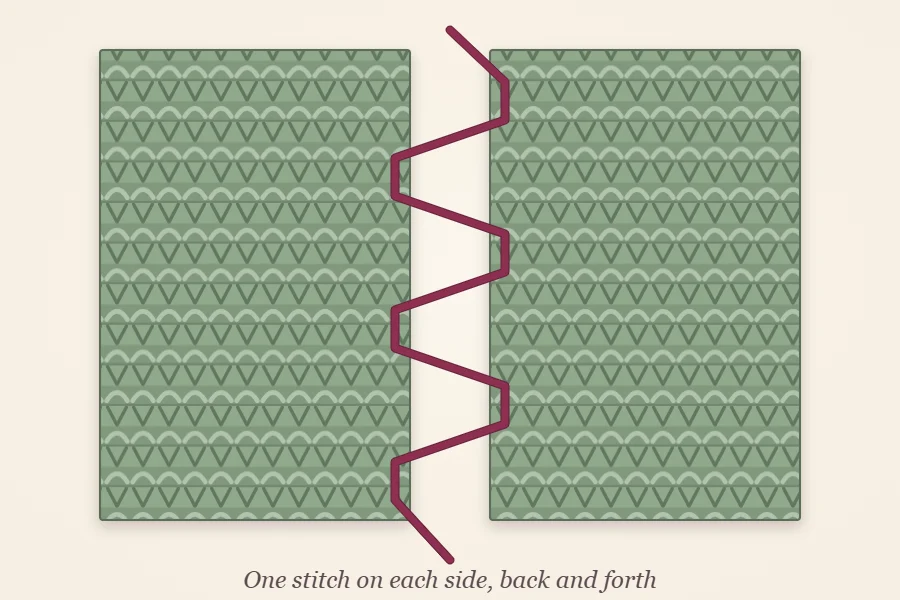
- Lay the two ends edge to edge on a table, with the side you want on the outside facing up. Line up the corners.
- Thread the tapestry needle. If you are using a new strand, leave a tail of at least 6 in (15 cm) to weave in later.
- On the first edge, slide the needle under one whole stitch in the row just inside the edge: both strands of the V on smooth fabric, or the loop of the nearest bump on garter stitch.
- Cross to the other edge and pick up the matching stitch in the same way.
- Go back to the first edge and pick up the next stitch along. Keep alternating, one stitch on each side, so the yarn makes a zigzag between the edges.
- After every four or five stitches, pull the yarn gently until the two edges meet. Stop there; do not tighten further.
- At the far corner, take the needle through to the inside and weave in the tail.
Because you pick up one stitch for one stitch, the seam stays even only if the counts match. Before pulling tight on the last few stitches, check that the same number remains on each side.
Tip
Pull the seam just snug enough that the edges touch. A seam drawn tighter than the knitting puckers and makes a stiff line across a fabric that should stretch.
The quicker option: whipstitch
Whipstitch is simpler and faster, and on garter stitch or a thick, textured yarn it is hard to tell from mattress stitch. Hold the two edges together with the outside of the scarf facing out on both. Bring the needle through the outermost loop of both edges from back to front, carry the yarn over the top, and repeat in the next pair of loops. Every stitch goes in the same direction, wrapping around the edge.
It leaves a small ridge on one side. Put that side on the inside of the loop. On a scarf with a half twist the ridge will be visible for part of the loop, so mattress stitch is the cleaner choice there.
The next step up: three-needle bind-off
A sewn seam joins two finished edges, so it always has a little bulk. The alternative is to join live stitches, which gives a flatter, stretchier join. It needs planning from the first row.
- Begin with a provisional cast-on: a cast-on worked over waste yarn that can be removed later, leaving open loops instead of a finished edge.
- Knit the scarf, but do not bind off. Leave the last row on the needle.
- Remove the waste yarn and slip the freed loops onto a second needle. You will often find one loop fewer than you cast on; pick up an extra strand at the edge so the two needles hold the same number.
- Hold the two needles parallel with the outside of the scarf facing inward. With a third needle, knit the first stitch on the front needle together with the first stitch on the back needle. Do it again, then pass the first stitch on the right needle over the second. Continue across.
The result is a single neat ridge on the inside of the loop. It is worth trying on a second infinity scarf once the sewn version feels easy.
Fixing a join you do not like
A sewn seam is reversible. Find the end of the seaming yarn, unpick it with the tip of the tapestry needle one stitch at a time and pull it out. Take care to cut only the seaming strand, never the scarf.
- Puckered seam: it was pulled too tight. Redo it with a looser hand.
- One edge longer than the other at the end: you skipped stitches on one side. Unpick and match stitch for stitch.
- Gaps showing between stitches: you picked up too far from the edge or skipped a stitch. Work closer to the edge.
- Unwanted twist: unpick fully, lay the scarf flat and pin again before sewing.
Finish by burying each tail along the seam or a ridge and changing direction once, as described in how to weave in ends. If the loop turns out a size you would change next time, the infinity scarf size guide lists the usual circumferences.
Frequently asked questions
What is the easiest way to join the ends of an infinity scarf?
Sew the cast-on edge to the bind-off edge with a tapestry needle and the same yarn. Whipstitch is the quickest method; mattress stitch takes slightly longer and gives a flatter, less visible seam.
How do I add a twist to an infinity scarf?
Lay the scarf flat, flip one short end over once so its underside faces up, then bring the ends together and seam them. Turn it over only once.
How much yarn do I need to seam an infinity scarf?
A strand about three times the width of the scarf is enough for the seam, with a little extra to weave in. A long cast-on or bind-off tail can do the job.