Chunky Knit Scarf: An Easy Garter Pattern in Super Bulky Yarn
A 14-stitch garter scarf in super bulky yarn on US 15 (10 mm) needles, with the arithmetic that shows why it has about one-fifth of the stitches of a worsted scarf.
Tutorial at a glance
Materials
- Large-eye tapestry needle
- Scissors
- Tape measure
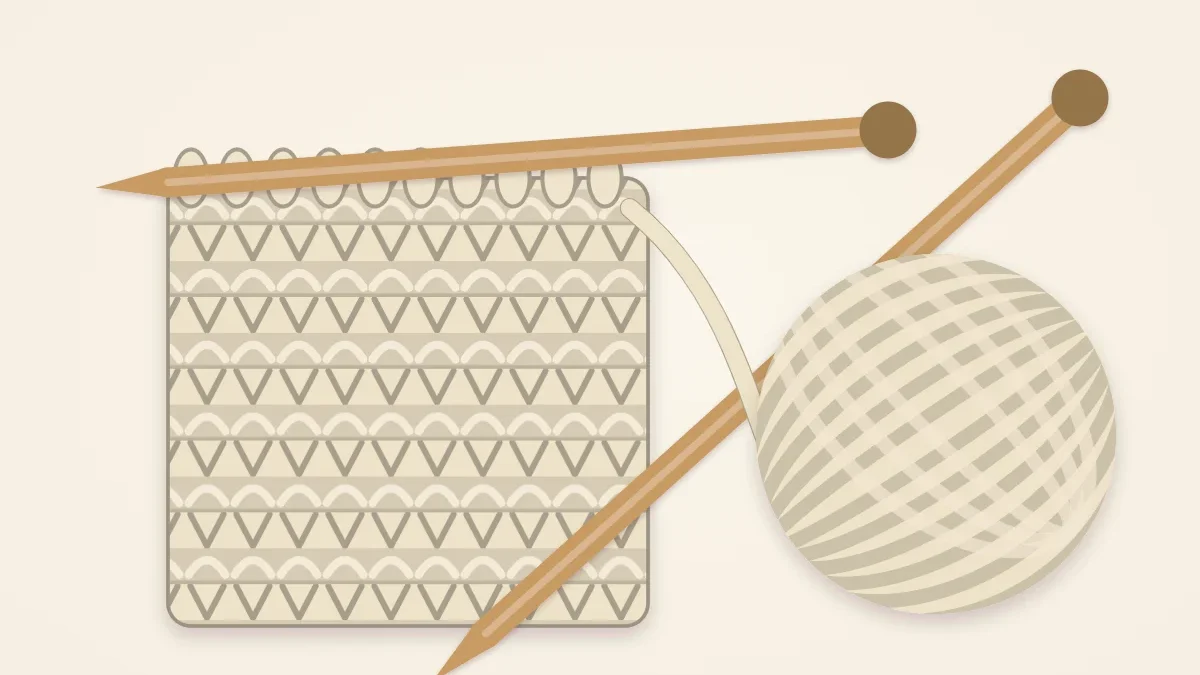
Fourteen stitches. That is the whole width of this scarf. In super bulky yarn each stitch is about half an inch wide, so a row takes seconds and the fabric grows visibly while you watch. The stitch is garter, which means you knit every row and never purl. If you want a finished scarf in days and not weeks, this is the project to pick.
Why a chunky scarf works up so quickly
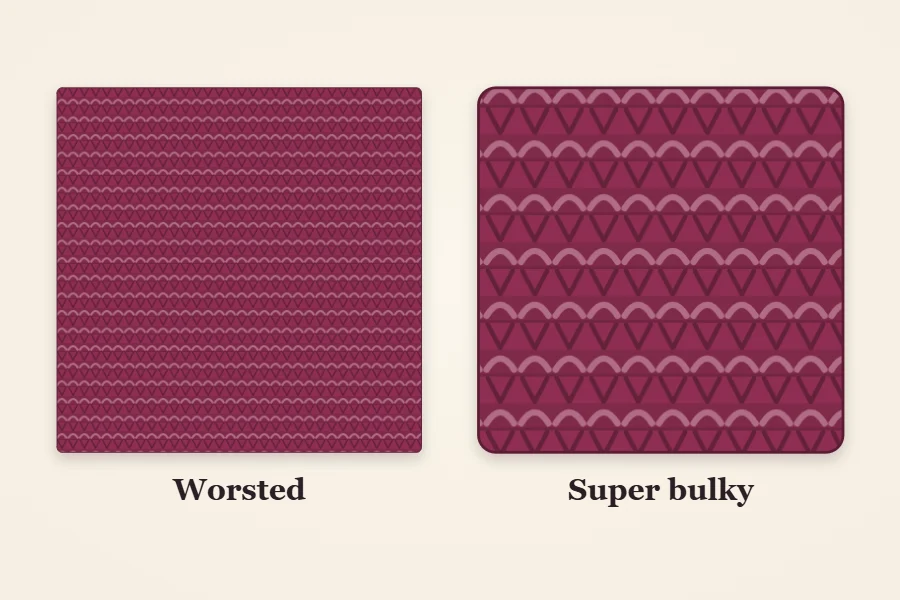
Speed in knitting comes down to how many stitches the finished piece contains. Thicker yarn makes bigger stitches, so fewer of them cover the same area. The saving is larger than it first appears, because a thick stitch is both wider and taller.
Compare a 7 x 60 in (18 x 152 cm) garter scarf in two yarns, using typical gauges:
| Worsted (#4) on US 8 (5 mm) | Super bulky (#6) on US 15 (10 mm) | |
|---|---|---|
| Stitches per inch | About 4.5 | About 2 |
| Cast on for 7 in | 31 stitches | 14 stitches |
| Rows per inch | About 9 | About 4 |
| Rows in 60 in | About 540 | About 240 |
| Total stitches | 31 x 540 = 16,740 | 14 x 240 = 3,360 |
The chunky scarf has roughly one-fifth of the stitches. Each big stitch takes a moment longer to form than a small one, so it is not five times faster in practice, but the difference is still large.
What you need
- Yarn: super bulky weight (#6), about 150 yd (137 m). The typical range for a scarf this size is roughly 120-180 yd (110-165 m), so treat the figure as an estimate and buy by the yardage on the label, not by the number of balls.
- Needles: US 15 (10 mm), straight or circular.
- Notions: a large-eye tapestry needle (a standard one will not take yarn this thick), scissors, tape measure.
Super bulky yarn is usually knit on US 11 to US 17 (8-12.75 mm) needles. US 15 sits in the upper half of that range on purpose: garter stitch in thick yarn becomes stiff and board-like if it is knit tightly, and a larger needle keeps the fabric soft enough to wrap. How the strand is constructed matters as much as its thickness; the guide to super bulky yarn for scarves explains which types hold up and which pill.
Chunky garter scarf pattern
Finished size: about 7 in (18 cm) wide and 60 in (152 cm) long.
Gauge: about 8 stitches to 4 in (10 cm) in garter stitch, which is 2 stitches per inch. 14 stitches ÷ 2 = 7 in.
Abbreviations: CO (cast on), BO (bind off), k (knit), st(s) (stitch or stitches).
- CO 14 sts loosely.
- Every row: k all 14 sts.
- Repeat until the scarf measures 60 in (152 cm). At a typical gauge that is about 120 garter ridges, since 2 rows make 1 ridge and there are about 2 ridges to the inch.
- Stop while you still have about 28 in (71 cm) of yarn for the bind-off, four times the scarf width.
- BO all sts loosely. Cut the yarn, leaving a tail of at least 6 in (15 cm), and pull it through the last stitch.
Changing the width
Garter stitch works on any number of stitches, so the adjustment is simple arithmetic at 2 stitches per inch: 12 stitches for 6 in (15 cm), 16 stitches for 8 in (20 cm), 20 stitches for a 10 in (25 cm) wrap-style scarf. Wider scarves need more yarn in proportion. Sixteen stitches use about 14 percent more than fourteen.
Optional neater edge
Big stitches make big edge loops, and uneven ones are easy to see. For a smooth chain along each side, slip (sl) the first stitch of every row purlwise with the yarn in front (wyif), then move the yarn to the back between the needles and knit to the end. The stitch count stays at 14. More detail is in neat scarf edges.
Handling big needles
Needles of 10 mm feel clumsy for the first few rows, especially if you learned on US 8. A few adjustments help.
- Choose wood or bamboo. They are lighter than metal at this size and grip the yarn, so 14 loose stitches are less likely to slide off the end.
- Consider a circular needle used flat. You knit back and forth exactly as on straights, but the weight of the scarf rests on the cable in your lap and not on your wrists. This matters more as the scarf gets long and heavy.
- Loosen your grip. Hold the needles close to the tips and let the needle diameter set the stitch size. Pulling each stitch tight makes thick yarn hard to knit into on the next row.
- Make larger movements. The yarn has farther to travel around a thick needle. Wrapping with the whole hand, not just a fingertip, is normal here.
The principles for matching needle to yarn are the same at every thickness and are set out in needle size for scarves.
Tip
To measure a long-tail cast-on tail in thick yarn, wrap the yarn around the needle 14 times, once for each stitch, then add 6 in (15 cm) before making the slip knot. That gives enough tail without wasting a yard of expensive yarn.
Weight and length choices
A chunky scarf is heavy. The yarn label lists yards and ounces (or meters and grams) per ball; multiply out your yardage to see what the finished scarf will weigh before you commit. Fiber changes the answer: wool and wool blends are lofty for their thickness, while dense cotton or tightly spun acrylic of the same weight category can feel noticeably heavier around the neck.
That weight affects how long to make it.
- About 60 in (152 cm) drapes around the neck once with both ends hanging, or wraps once in a loose loop. It is the easiest length to wear in thick fabric and the one used here.
- 65-70 in (165-180 cm) gives a full wrap with ends to spare, but adds bulk under the chin and needs more yarn in direct proportion: 70 in uses about 17 percent more than 60 in.
- Under 55 in (140 cm) tends to be too short to stay put unless you pin it or tuck it into a coat.
Watch out
Garter stitch stretches lengthwise under its own weight, and a heavy scarf stretches more. Measure the length with the scarf held up and hanging, not lying flat on a table, or the finished piece can end up several inches longer than you planned.
Joining yarn and finishing
Super bulky balls are short on yardage, so you will join a new one at least once. Do it at the start of a row: drop the old yarn, leave a 6 in (15 cm) tail of each, and begin knitting with the new ball. Avoid knots, which make a hard lump in fabric this thick.
Thick tails are harder to hide than thin ones. Run each tail along a garter ridge for about 2 in (5 cm), then turn and come back in the opposite direction through the neighboring ridge. If the yarn is plied, you can separate the strands and weave them in two different directions to spread the bulk. The full methods are in how to weave in ends.
Garter stitch lies flat, so blocking is optional. If you would like the same speed with a stretchier, deeper texture, the chunky ribbed scarf is the natural next step.
Frequently asked questions
How many stitches do I cast on for a chunky scarf?
In super bulky yarn at about 2 stitches per inch, 14 stitches give a scarf about 7 in (18 cm) wide. Use 12 stitches for 6 in or 16 stitches for 8 in.
Is a chunky scarf a good first project?
Yes. Large stitches are easy to see and count, the scarf grows quickly, and garter stitch needs only the knit stitch. The big needles feel awkward for a few rows, then become comfortable.
Why is my chunky scarf so stiff?
The stitches are too tight for the yarn. Go up one or two needle sizes and hold the yarn more loosely; garter stitch in thick yarn needs room to stay soft.