Chunky Ribbed Scarf Pattern in 1×1 Rib
A 1x1 ribbed scarf for bulky or super bulky yarn, worked over an odd number of stitches so both edges match. Includes cast-on numbers, yardage estimates and ways to keep thick rib soft.
Tutorial at a glance
Materials
- Tapestry needle with a large eye
- Scissors
- Tape measure
One-by-one rib in thick yarn gives you about the squishiest scarf two stitches can make: deep, springy columns that look the same on both sides and never curl at the edges. This version is worked over an odd number of stitches so a knit column sits at each edge of the right side, and it comes with numbers for both super bulky and bulky yarn.
What you need
- Yarn: super bulky (#6), roughly 160-220 yd (145-200 m), or bulky (#5), roughly 230-300 yd (210-275 m). Both are estimates for a scarf about 7 in wide and 65 in long.
- Needles: US 13 (9 mm) for super bulky, or US 10.5 (6.5 mm) for bulky. Straight needles work; a circular needle used flat keeps the weight of a heavy scarf in your lap instead of on your wrists.
- Notions: a tapestry needle with a large eye, scissors and a tape measure.
Pick a smooth, round yarn in a solid color so the columns stay crisp. The guide to choosing bulky and super bulky yarn explains why a plied strand usually holds rib better than a loose single ply, and the needle size guide covers what to do if your yarn label suggests something different from the sizes above.
Finished size and cast-on numbers
Rib is measured relaxed, lying flat without being stretched. The gauges below are typical for these yarn and needle pairings, not a requirement. Your own fabric may come out a little wider or narrower, and a scarf is forgiving either way.
| Version | Needles | Typical gauge in relaxed rib | Cast on | Width |
|---|---|---|---|---|
| Super bulky (#6) | US 13 (9 mm) | About 2.5 sts per inch | 17 sts | About 7 in (18 cm) |
| Bulky (#5) | US 10.5 (6.5 mm) | About 3.5 sts per inch | 25 sts | About 7 in (18 cm) |
The arithmetic: 17 stitches divided by 2.5 per inch is 6.8 in, and 25 stitches divided by 3.5 per inch is 7.1 in. Both are worked to about 65 in (165 cm) long. To change the width, add or remove stitches two at a time so the total stays odd: 15 or 19 for super bulky, 23 or 27 for bulky.
Why an odd number of stitches
With an even count, 1×1 rib starts with a knit and ends with a purl, so the two side edges look different. With an odd count, every right-side row begins and ends with a knit stitch. The scarf is symmetrical, and the edge columns roll very slightly toward the back, which hides any uneven edge stitches.
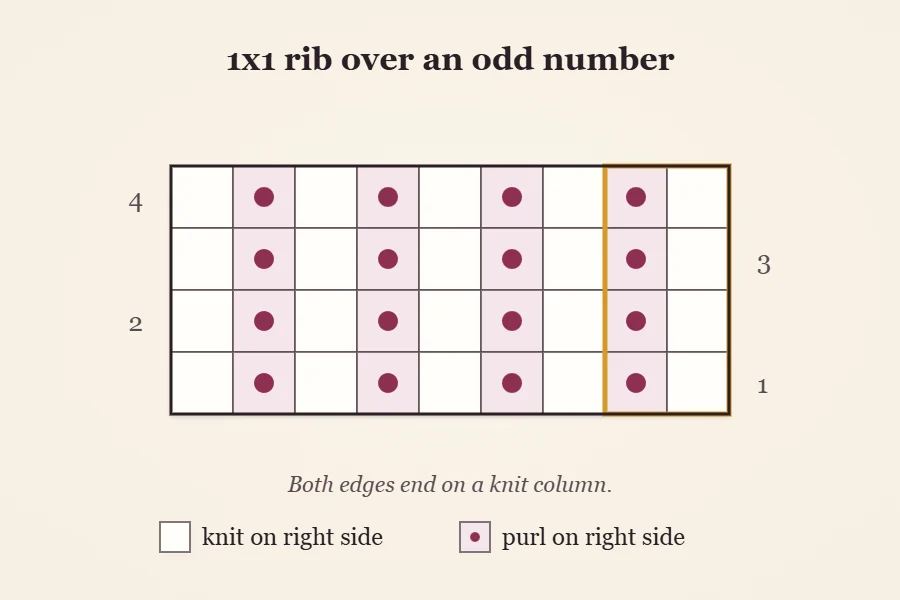
In the chart an empty square is a knit stitch as seen from the right side and a dot is a purl. Each column keeps the same symbol all the way up, which is what rib is: knits stacked on knits, purls stacked on purls.
The pattern
Abbreviations: CO (cast on), BO (bind off), k (knit), p (purl), st(s) (stitch or stitches), RS (right side), WS (wrong side).
- CO 17 sts for super bulky or 25 sts for bulky, using a long-tail cast-on worked loosely. Leave a tail of at least 6 in (15 cm).
- Row 1 (RS): k1, *p1, k1; repeat from * to the end of the row.
- Row 2 (WS): p1, *k1, p1; repeat from * to the end of the row.
- Repeat Rows 1 and 2 until the scarf measures about 65 in (165 cm), or about as long as the wearer is tall, ending after a Row 2.
- BO in pattern: knit the knit stitches and purl the purl stitches as you bind off, keeping the stitches loose. Cut the yarn, leaving at least 6 in (15 cm), and pull it through the last stitch.
Check the counts against the repeat: one edge stitch plus eight pairs is 17, and one edge stitch plus twelve pairs is 25. If you lose your place mid-row, read the stitch below the one on your left needle. A smooth V means knit it; a bump means purl it.
Tip
Before you start the bind-off, make sure the working yarn is at least four times the width of the scarf, about 28 in (71 cm) here. Thick yarn runs out faster than it looks.
Rib eats yarn, so buy with a margin
Rib pulls in sideways. To reach the same 7 in width you cast on more stitches than you would in garter, and every one of those stitches is worked on every row. A garter scarf of this size in super bulky yarn typically takes about 120-180 yd (110-165 m); the same scarf in 1×1 rib usually lands higher, which is why the estimate above starts at 160 yd.
Thick yarn also comes in short skeins. Many super bulky skeins hold well under 100 yd, so a full-length ribbed scarf often needs three or more. Buy them together from the same dye lot, and plan on one spare. If you would rather measure than guess, the weigh-your-swatch method in how much yarn a scarf takes works well for rib.
Keeping chunky rib soft instead of stiff
Thick yarn worked tightly in rib turns into something closer to a doormat than a scarf. Three habits prevent it:
- Go up a needle size if the fabric feels dense. After 3 or 4 in, fold the fabric over your hand. If it stands up rather than drapes, rip back and move to US 15 (10 mm) for super bulky or US 11 (8 mm) for bulky.
- Do not tug the yarn when switching between knit and purl. Bring it between the needles to the front or back and carry on. Pulling each stitch tight closes up the ribs and hardens the fabric.
- Cast on and bind off loosely. A tight edge makes the ends flare and feel rigid. Casting on over a needle one or two sizes larger is an easy fix.
Watch out
Do not stretch rib wide when you block it, and never press acrylic with an iron. A ribbed scarf pinned open loses the spring that makes it rib.
Finishing
Join new skeins at a side edge rather than mid-row; a knot or overlap in the middle of thick fabric shows from both sides. Weave each tail vertically along a knit column for a couple of inches and then back down the neighboring column, following the method in weaving in ends on a scarf. With very thick yarn it helps to split the tail into two thinner strands and weave them in opposite directions.
Most ribbed scarves need no blocking at all. If the fabric looks uneven, wash it gently, lay it flat without stretching and let it dry. For a flat, quicker project in the same yarn, the chunky garter scarf uses fewer stitches and less yardage.
Frequently asked questions
How many stitches do I cast on for a chunky ribbed scarf?
For a scarf about 7 in (18 cm) wide, cast on 17 stitches in super bulky yarn on US 13 (9 mm) needles, or 25 stitches in bulky yarn on US 10.5 (6.5 mm) needles. Keep the number odd so both edges are knit columns on the right side.
Does a ribbed scarf use more yarn than a garter scarf?
Usually, yes. Rib pulls in, so you need more stitches to reach the same width, and that adds yardage. Buy one skein more than a garter estimate suggests.
Why does my chunky rib feel stiff?
The needles are probably too small for the yarn, or you are pulling the yarn tight when you switch between knit and purl. Going up one or two needle sizes gives a softer fabric with more drape.