Garter Stitch Scarf Pattern: Knit Every Row
A classic garter stitch scarf on 28 stitches in worsted yarn, with a slipped edge option, a cast-on table for other widths and a simple way to count ridges.
Tutorial at a glance
Materials
- Tapestry needle
- Scissors
- Tape measure
- Removable stitch markers (optional)
Garter stitch is the fabric you get when you knit every stitch of every row. It lies flat, it is identical on both sides, and it is thick enough to be warm in a single layer, which is exactly what a scarf needs. This pattern is a plain adult garter scarf with an optional slipped edge, followed by the arithmetic for changing its width and a few variations.
Pattern at a Glance
| Detail | This scarf |
|---|---|
| Finished size | About 7 in (18 cm) wide and 65 in (165 cm) long |
| Yarn | Worsted weight (#4), about 300 yd (275 m) |
| Needles | US 8 (5 mm) straight needles |
| Gauge | About 16 stitches and 32 rows (16 ridges) to 4 in (10 cm) in garter stitch |
| Cast on | 28 stitches |
| Skills | Cast on, knit, bind off |
Gauge does not have to be exact for a scarf. A stitch or two off over 4 in changes the width by well under an inch, and the scarf still fits.
Why Garter Stitch Suits a Scarf
Three properties make garter the default scarf fabric. It does not curl at the edges the way stockinette does, so it needs no border. It is reversible, which matters for something that is seen from both sides every time it is wrapped. And the ridges trap air, so the fabric is noticeably thicker than the same yarn in a smooth stitch.
The price is speed. Garter rows are compressed, so it takes about twice as many rows as stitches to cover the same distance. Expect the length to grow slowly.
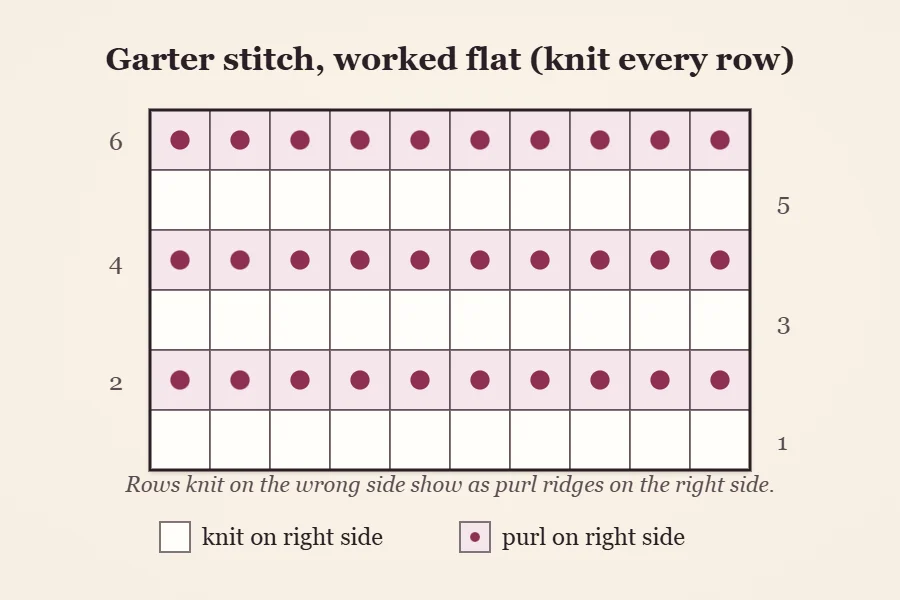
The chart can look confusing at first, because it shows rows of dots even though you never purl. A chart always shows the fabric as seen from the right side (RS). A stitch knit on a right-side row appears as a smooth V, drawn as an empty square. A stitch knit on a wrong-side (WS) row shows its bump on the right side, so it is drawn as a dot. Knit every row, and the right side shows one smooth row and one bumpy row in turn. Each bumpy row is a ridge.
Choosing Your Width
The cast-on number is the width you want multiplied by your stitches per inch. At the gauge above, 16 stitches over 4 in is 4 stitches per inch.
| Width | Arithmetic | Cast on |
|---|---|---|
| 5 in (13 cm), child or narrow | 5 x 4 | 20 stitches |
| 6 in (15 cm) | 6 x 4 | 24 stitches |
| 7 in (18 cm), standard | 7 x 4 | 28 stitches |
| 8 in (20 cm) | 8 x 4 | 32 stitches |
Garter stitch works over any number of stitches, odd or even, so you can round freely. If you knit tightly or loosely, measure your own fabric first. The guide to a gauge swatch for scarves shows how to count stitches per inch and turn that into a cast-on number.
The Pattern
Abbreviations: CO (cast on), k (knit), sl (slip), st(s) (stitch or stitches), wyif (with yarn in front), BO (bind off).
Plain edge version
- CO 28 sts, loosely.
- Every row: k28.
- Repeat until the scarf measures 65 in (165 cm), or the length you want, ending with a full row.
- BO all sts loosely. Cut the yarn, leaving a 6 in (15 cm) tail, and pull it through the last st.
Slipped edge version
For a smoother chain along each side, replace step 2 with this row:
- Every row: sl 1 purlwise wyif, move the yarn to the back between the needles, k27.
That is 1 slipped stitch plus 27 knit stitches, 28 in all, so the count never changes. Slipping purlwise means inserting the right needle into the stitch as if to purl, from right to left, and moving it across without working it. The reasons this works, and other edge options, are in the guide to neat scarf edges.
Watch out
After slipping the first stitch, the yarn must go to the back between the needle tips, not over the top of the right needle. Carried over the top, it forms an extra loop and the scarf starts to widen.
Counting Ridges
Two rows make one ridge. At 32 rows to 4 in there are 8 rows, or 4 ridges, in every inch, so a 65 in scarf has roughly 260 ridges. You will not count them all, but ridges are useful in two ways.
- Checking progress: clip a removable marker into the fabric every 20 ridges. At 4 ridges per inch, each marked section is about 5 in (13 cm).
- Matching lengths: if you plan stripes or want two ends to mirror each other, count ridges rather than measuring, because garter stretches under the tape.
To count, look at one side only and count the raised lines. Each one is 2 rows. The loops sitting on the needle are a row in progress and are not counted as a ridge.
How Much Yarn It Takes
A 7 x 65 in garter scarf in worsted yarn typically uses somewhere between 250 and 350 yd (230-320 m). The spread comes from gauge and from the yarn itself: a dense, tightly knit fabric takes more yarn per inch than a relaxed one. Treat 300 yd (275 m) as a working estimate and buy an extra ball if the shop’s return policy allows it. The article on how much yarn a scarf needs explains how to weigh a swatch for a closer figure.
Leave a strand about four times the width of the scarf for the bind-off. For this scarf that is 4 x 7 = 28 in (71 cm).
Variations on the Same Scarf
- Stripes: garter stripes are tidy when you change color on a right-side row. The striped scarf pattern covers carrying yarn up the side.
- Thicker yarn: the same idea in super bulky yarn needs far fewer stitches and rows. See the chunky knit scarf for its own numbers.
- Softer drape: go up to US 9 (5.5 mm) or US 10 (6 mm) needles with the same yarn. The fabric becomes looser and wider, so recheck your stitches per inch before casting on.
- Child size: cast on 20 sts for 5 in (13 cm) and knit to 40 in (100 cm).
Finishing
Weave each tail along a ridge with a tapestry needle, change direction once, and trim. Garter stitch lengthens a little under its own weight once it is worn, so if you are between two lengths, stop at the shorter one. Wool responds well to a gentle wet block that evens out the stitches. Acrylic will not hold a wet block and should never be pressed with an iron.
Frequently asked questions
Does a garter stitch scarf need a border?
No. Garter stitch lies flat on its own, so the whole scarf can be knit edge to edge. A slipped first stitch is optional and only makes the sides look smoother.
Can I cast on an odd number of stitches for garter stitch?
Yes. Garter stitch works over any number of stitches, so choose the count that gives the width you want.
Why is my garter scarf growing so slowly?
Garter rows sit close together, at about 8 rows per inch in worsted yarn, so each inch of length takes noticeably more rows than a smooth stitch would. That is normal for the stitch and not a sign of a mistake.