Why Knitted Scarves Curl and How to Stop It
Stockinette stitch rolls at the edges because of how the stitch is built. Here is why it happens and the fixes that work: flat stitches, borders, tubes and the limits of blocking.
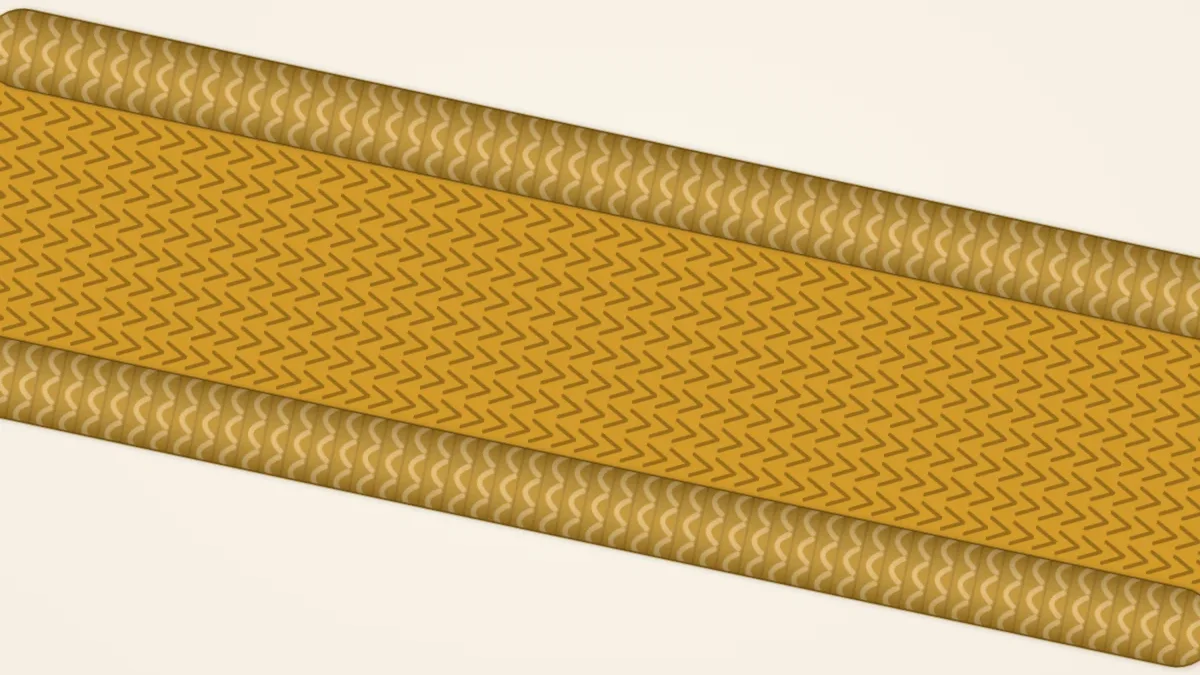
A scarf that rolls itself into a tube is almost always knit in stockinette stitch: knit on the right side (RS), purl on the wrong side (WS). The curl is not a tension problem and it is not something you did wrong. It is built into the structure of that fabric, which is why washing, tugging and wearing never cure it. The reliable fixes are to choose a stitch that balances itself, to frame the stockinette with one that does, or to turn the roll into a deliberate tube.
What Causes the Curl
A knitted stitch is not the same on its two faces. On the knit face each stitch shows as a smooth V. On the purl face it shows as a horizontal bump. The yarn in the Vs and the yarn in the bumps bend in different directions, and each tries to straighten out. In stockinette, every V is on one face and every bump is on the other, so all of that pull acts the same way across the entire piece and nothing opposes it.
The result follows a fixed pattern:
- The side edges roll toward the purl side, to the back of the fabric.
- The cast-on and bind-off edges roll toward the knit side, to the front.
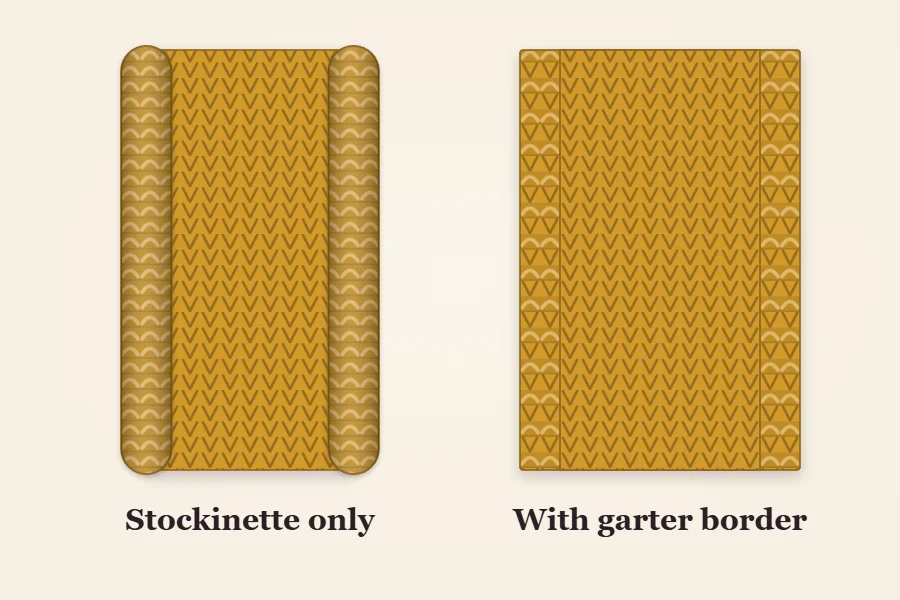
On a long, narrow piece like a scarf, the two side rolls meet in the middle and the scarf becomes a cord with the purl bumps hidden inside. Tighter knitting and springy yarns such as wool curl harder. Loose knitting in a limp fiber curls less, but it still curls.
Stitches That Lie Flat
A fabric stays flat when knit and purl stitches appear on both faces in roughly equal amounts, so the pull in one direction is canceled by the pull in the other. Garter stitch alternates them row by row. Ribbing alternates them in columns. Seed stitch alternates them stitch by stitch.
| Stitch | Curls? | Same on both sides? | Stitch count |
|---|---|---|---|
| Stockinette | Yes, strongly | No | Any number |
| Garter | No | Yes | Any number |
| 1×1 rib | No | Yes | Odd number |
| 2×2 rib | No | Yes | Multiple of 4 + 2 |
| Seed stitch | No | Yes | Odd number |
| Broken rib | Very little | No, but both are presentable | Odd number |
If you have not cast on yet, picking from this list is the simplest answer. A garter stitch scarf needs only the knit stitch. A 2×2 ribbed scarf is stretchy and close-fitting, and a seed stitch scarf has a pebbled surface that is flat and firm. The overview of the best stitches for scarves compares them side by side.
Adding a Garter or Seed Border
If you want the smooth look of stockinette, you can surround it with a frame of flat stitches. The border resists the roll at each edge.
Abbreviations: CO (cast on), k (knit), p (purl), st(s) (stitch or stitches), BO (bind off).
Garter border, 30 stitches
In worsted-weight yarn on US 8 (5 mm) needles this gives a scarf of roughly 7 in (18 cm).
- CO 30 sts.
- Rows 1-6: knit every st. This makes 3 garter ridges along the bottom.
- Row 7 (RS): k30.
- Row 8 (WS): k4, p22, k4.
- Repeat rows 7 and 8 to the length you want, ending after a row 8.
- Knit 6 rows for 3 ridges at the top, then BO.
Check: 4 + 22 + 4 = 30. The first and last 4 sts are knit on every row, so they form garter stitch, and the 22 in the middle form stockinette.
Seed border, 31 stitches
- CO 31 sts.
- Rows 1-6: k1, *p1, k1; repeat from * to the end.
- Row 7 (RS): (k1, p1) twice, k1, k21, (k1, p1) twice, k1.
- Row 8 (WS): (k1, p1) twice, k1, p21, (k1, p1) twice, k1.
- Repeat rows 7 and 8, then work 6 rows as row 1 and BO in pattern.
Check: 5 + 21 + 5 = 31, an odd number, so the seed stitch at the bottom lines up with the borders above it.
Watch out
A border reduces the curl but does not remove the force behind it. One or two edge stitches are not enough: the stockinette simply folds them over. Use at least 4 border stitches on each side, and more on a wide scarf. Even then the back of the scarf shows purl bumps, so it will not be reversible.
What Blocking Can and Cannot Do
Blocking means wetting or steaming the finished piece and letting it dry in the shape you want. On wool and other animal fibers, a wet block relaxes stockinette and can flatten a mild curl, particularly at the cast-on and bind-off edges. It does not change the structure of the stitches. On an unbordered stockinette scarf, the side edges start rolling again with wear and return fully after the next wash.
Acrylic does not hold a wet block at all. Hovering steam above it, without touching the fabric, can relax it, but too much heat permanently flattens the fibers, and an iron pressed onto acrylic will ruin it. The full method for each fiber is in the guide on how to block a knitted scarf. Treat blocking as a finishing touch for a scarf that is already close to flat, not as a cure for one that is not.
Knitting a Tube or Doubling the Fabric
The other approach is to stop fighting the roll. A tube of stockinette has no side edges, so there is nothing to curl, and both visible faces are smooth knit stitches.
- Knit in the round: worked on circular or double-pointed needles, stockinette becomes a seamless tube that you press flat into a double-thickness scarf.
- Knit flat and seam: knit a stockinette strip twice the width you want, fold it lengthwise with the purl sides together and sew the long edges.
Either way you are knitting twice the fabric. For a doubled scarf 7 in (18 cm) wide you need 14 in (36 cm) of fabric. At about 4.5 stitches per inch, a common stockinette gauge for worsted yarn, that is 14 x 4.5 = 63 stitches, and roughly double the yarn of a single-layer scarf. The reward is a very warm scarf with no wrong side.
Rescuing a Scarf That Already Curls
If the scarf is finished, or too far along to restart, the realistic options are these.
- Seam it into a tube. Let it roll, then sew the two long edges together. You lose half the width but gain a neat, double-layer scarf.
- Block it and accept some roll. This suits wool scarves worn loosely, where a soft curl at the edges reads as part of the style.
- Rip back and add a border. If you are only a few inches in, restarting with one of the bordered versions above costs little.
What does not work is knitting more tightly, pressing harder, or hoping the weight of a longer scarf will pull it straight. The curl comes from the stitch, so the fix has to change the stitch or its shape.
Frequently asked questions
Will blocking stop my stockinette scarf from curling?
Only partly and only for a while. Wet blocking relaxes wool enough to flatten a mild curl, but the side edges roll again with wear, and acrylic does not hold a wet block at all.
How many border stitches do I need to keep a scarf flat?
Use at least 4 stitches of garter or seed stitch on each side, plus about 6 rows at the top and bottom. One or two edge stitches will just fold over with the stockinette.
Which scarf stitches do not curl?
Garter stitch, 1x1 and 2x2 rib, and seed stitch all lie flat because they mix knit and purl stitches on both faces. They also look the same on both sides.