Basketweave Scarf Pattern: A Textured Knit and Purl Scarf
A basketweave scarf made from 4-stitch, 4-row blocks of knit and purl on 36 stitches, with all 8 rows written out and tips for keeping your place.
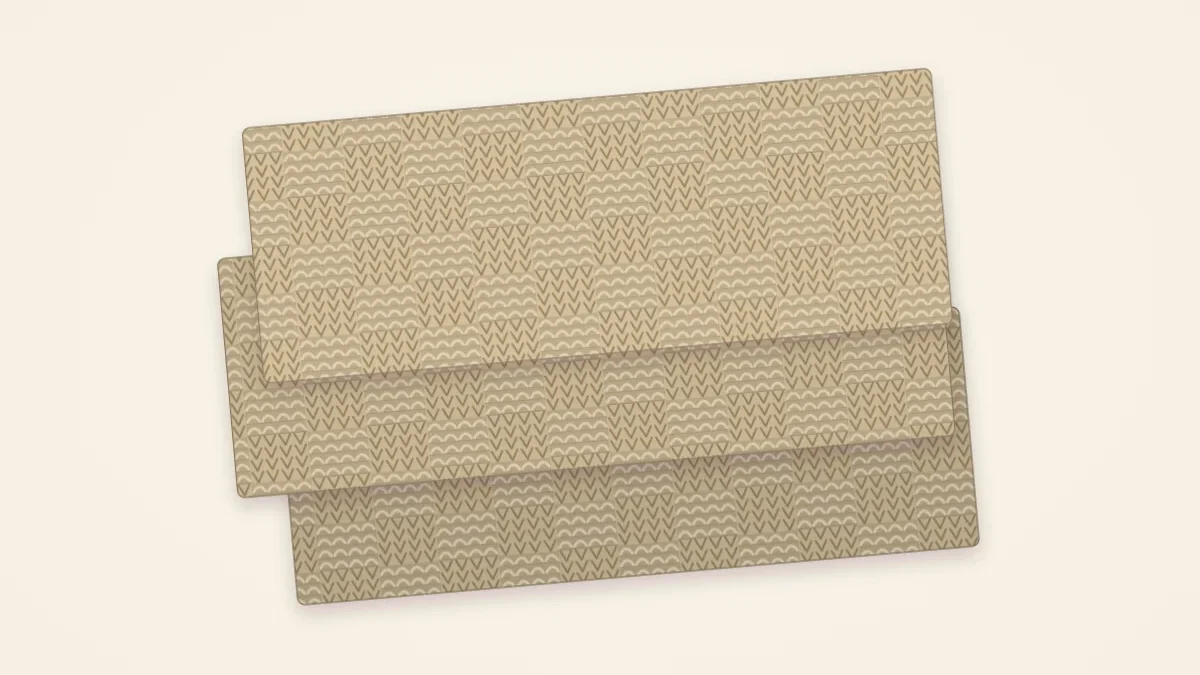
Tutorial at a glance
Materials
- Tapestry needle
- Scissors
- Tape measure
- Row counter (optional)
Basketweave looks like strips of fabric woven over and under each other, but nothing is woven and nothing is crossed. It is made from small squares of knit stitches set beside squares of purl stitches, and after a few rows the squares trade places. If you can knit, purl and count to four, you can knit this scarf.
How the texture works
A square of stitches that are smooth on the side facing you sits slightly forward. A square of purl bumps sits slightly back. Put them next to each other and the smooth squares appear to pass over the bumpy ones. Swap them every few rows and you get the checkerboard that gives the stitch its name.
In this pattern each block is 4 stitches wide and 4 rows tall. Two blocks side by side, plus the two blocks above them, make one full repeat of 8 stitches and 8 rows. The back of the fabric shows the same pattern with the blocks reversed, so the scarf has no wrong side to hide. And because knit and purl areas are balanced, the fabric lies flat instead of rolling the way plain stockinette does.
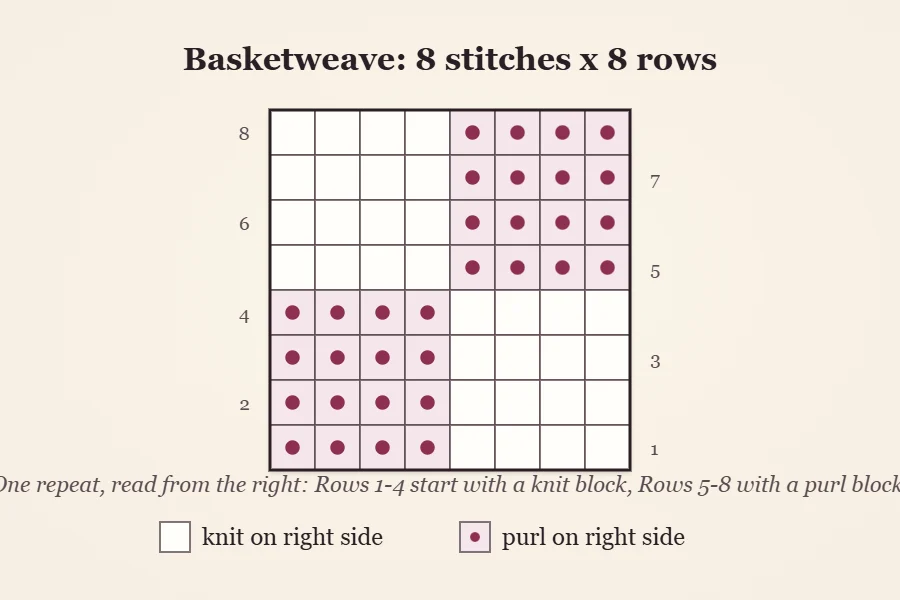
The chart shows one repeat as it looks from the right side. In the lower four rows a block of four empty squares sits next to a block of four dots. In the upper four rows the two blocks have changed sides.
Materials and finished size
| Item | What you need |
|---|---|
| Yarn | Worsted weight (#4), roughly 300-400 yd (275-365 m), smooth and in a light or medium solid color |
| Needles | US 8 (5 mm) straight needles |
| Notions | Tapestry needle, scissors, tape measure; a row counter is helpful |
| Cast on | 36 stitches |
| Finished size | About 7.5 in (19 cm) wide and 65 in (165 cm) long |
The yardage is an estimate; textured stitches use somewhat more yarn than garter. Yarn choice matters more here than in most scarves, because the pattern depends on light and shadow. Dark, fuzzy or multicolored yarn hides the blocks. A smooth plied yarn in a pale or mid-tone shade, such as oatmeal, shows them best. See the guide to the best yarn for scarves for fiber options.
The stitch count: a multiple of 8 plus 4
One repeat is 8 stitches: a knit block of 4 and a purl block of 4. An exact multiple of 8 would start each row with one kind of block and end with the other, and the two side edges would not match. Adding 4 more stitches gives one extra block, so every row begins and ends with the same kind.
For this scarf, 8 x 4 = 32, plus 4 = 36 stitches, which makes 9 blocks across. Other counts that fit the rule:
- 28 stitches (8 x 3 + 4): 7 blocks, about 6 in (15 cm) wide
- 36 stitches (8 x 4 + 4): 9 blocks, the pattern as written
- 44 stitches (8 x 5 + 4): 11 blocks, about 9 in (23 cm) wide
These widths assume roughly 4.75 stitches per inch, which is typical for this stitch in worsted yarn on US 8 (5 mm) needles: 36 divided by 4.75 is about 7.5 in. Your gauge may differ, and the gauge swatch guide shows how to measure it.
The pattern
Abbreviations: CO (cast on), BO (bind off), k (knit), p (purl), st(s) (stitch or stitches), RS (right side), WS (wrong side). Instructions between asterisks are repeated to the end of the row.
CO 36 sts.
- Row 1 (RS): k4, *p4, k4*.
- Row 2 (WS): p4, *k4, p4*.
- Row 3 (RS): k4, *p4, k4*.
- Row 4 (WS): p4, *k4, p4*.
- Row 5 (RS): p4, *k4, p4*.
- Row 6 (WS): k4, *p4, k4*.
- Row 7 (RS): p4, *k4, p4*.
- Row 8 (WS): k4, *p4, k4*.
Repeat Rows 1-8 until the scarf measures about 65 in (165 cm), ending after Row 4 or Row 8 so the last set of blocks is complete. BO in pattern, knitting the knit stitches and purling the purl stitches as you go, and keep the bind-off loose. You need a strand about four times the scarf width to bind off.
With 36 stitches, Rows 1-4 have 5 knit blocks and 4 purl blocks as seen from the right side, and Rows 5-8 have 5 purl blocks and 4 knit blocks. Rows 1 and 3 are the same as Rows 6 and 8 in wording, and Rows 2 and 4 match Rows 5 and 7. The only thing that changes is which side is facing you.
Keeping your place
The pattern is easy to read from the fabric once the first set of blocks is done.
- Within a set of four rows, knit the knits and purl the purls. A knit stitch shows a small V below the needle and a purl stitch shows a bump. Rows 2, 3 and 4 just repeat what Row 1 set up, and the same goes for Rows 6, 7 and 8 after Row 5.
- On Rows 1 and 5, do the opposite of what you see: purl over the Vs and knit over the bumps. These are the two rows where the blocks swap.
- To check how many rows a block has, count the Vs stacked in one column of a smooth block. Four Vs means the block is finished and the next row is a swap row.
Tip
Swap rows are always right-side rows. If you mark the right side with a safety pin or a loop of scrap yarn, you will never need to swap blocks on a row where the marker faces away from you.
If you count 37 stitches instead of 36, the yarn has probably gone over the needle when you moved it between a knit block and a purl block. Bring the yarn between the needle tips each time: to the back before knitting, to the front before purling.
Edges, finishing and blocking
The side edges of this scarf follow the blocks, so they alternate between smooth and bumpy every four rows. Some knitters like that; it can also look slightly scalloped. For a straighter edge, add 2 garter stitches at each side: CO 40 sts and knit the first 2 and last 2 sts of every row, working the 8-row pattern over the 36 sts between them. Other options are covered in the guide to neat scarf edges.
Leave tails of at least 6 in (15 cm) and weave them in along the boundary between two blocks, where the change in texture hides them. The method is in how to weave in ends.
Watch out
Block lightly. Wool can be soaked, laid flat and patted into shape, but stretching it hard or pressing it flattens the blocks and removes the woven look. Acrylic does not hold a wet block and must never be pressed with an iron.
Pinning and drying are explained in how to block a knitted scarf.
Variations
- Bigger blocks: blocks of 6 stitches and 6 rows need a multiple of 12 plus 6, for example 42 sts. Work k6, *p6, k6* and p6, *k6, p6* in sets of six rows.
- Bulky yarn: in bulky (#5) yarn on US 10 (6 mm) needles, 20 sts (8 x 2 + 4) gives five blocks and a quicker, thicker scarf.
- Softer drape: go up one needle size. The blocks will be less sharply defined and the fabric more fluid.
Frequently asked questions
Is basketweave stitch hard for a beginner?
It uses only knit and purl stitches, so it is a reasonable second or third scarf. The one thing to track is when four rows are complete and the blocks need to swap.
Does a basketweave scarf look the same on both sides?
Both sides show the same checkerboard of smooth and bumpy blocks, with the positions reversed. Neither side looks like a wrong side.
What yarn shows basketweave best?
A smooth, plied yarn in a light or medium solid color. Dark, fuzzy or variegated yarns hide the shadows that make the blocks visible.