Moss Stitch vs Seed Stitch: The Difference and Which to Use for a Scarf
US seed stitch swaps knits and purls on every row; US moss stitch swaps them every second row. UK patterns use "moss stitch" for the first one. Here is how to tell them apart and choose.
Two knitters can both say “moss stitch” and mean two different fabrics. In the United States, seed stitch and moss stitch are separate stitch patterns. In the United Kingdom, “moss stitch” is the name for what US patterns call seed stitch, and the US moss stitch goes by “double moss” or “Irish moss”. This site uses US terms throughout. The quickest way to avoid a mix-up is to ignore the name and read the row instructions, which never lie.
The naming at a glance
| What the fabric is | US name | UK name | Row repeat |
|---|---|---|---|
| Knits and purls swap on every row | Seed stitch | Moss stitch | 2 rows (1 row over an odd count) |
| Knits and purls swap every second row | Moss stitch | Double moss stitch or Irish moss stitch | 4 rows |
So a UK pattern that asks for “moss stitch” wants the smaller texture, and a US pattern that asks for “moss stitch” wants the larger one. If a pattern does not say where it was written, look at how many rows the repeat has.
How seed stitch is worked
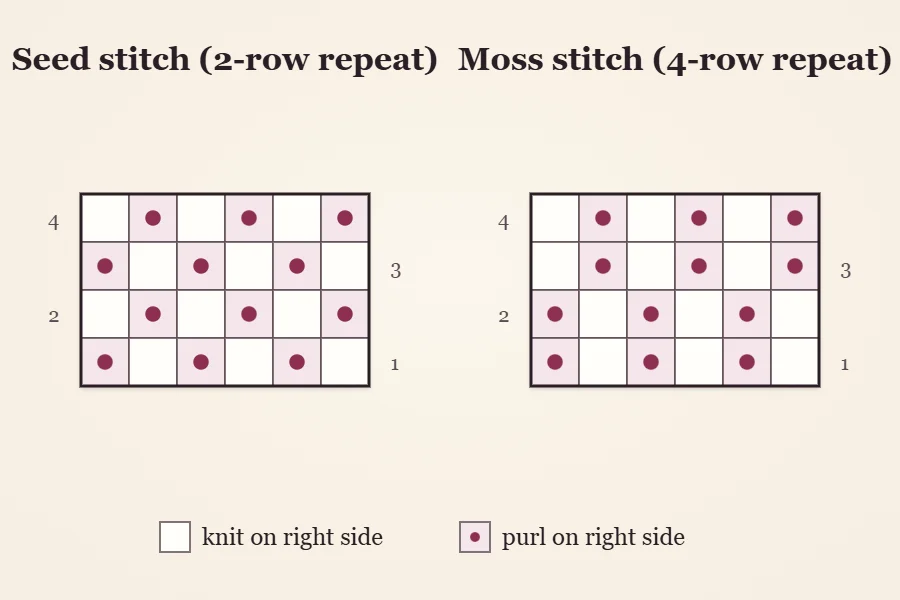
Seed stitch alternates one knit stitch (k) and one purl stitch (p) across the row, then offsets them on the very next row, so every knit sits directly above a purl.
Over an odd number of stitches (sts), every row is the same:
- Every row: k1, *p1, k1*; repeat from * to the end.
Over an even number, you need two rows:
- Row 1: *k1, p1*; repeat from * to the end.
- Row 2: *p1, k1*; repeat from * to the end.
Either way, the rule on the needle is “knit the purls, purl the knits” on every row. A full pattern with stitch counts is in the seed stitch scarf tutorial.
How moss stitch is worked
US moss stitch is worked over an even number of stitches with a four-row repeat:
- Rows 1 and 2: *k1, p1*; repeat from * to the end.
- Rows 3 and 4: *p1, k1*; repeat from * to the end.
Rows 1 and 2 together make two rows of ordinary 1×1 rib: on Row 2 you are knitting the stitches that face you as knits and purling the purls. On Row 3 you switch, and Row 4 again matches what faces you. The rule on the needle is therefore different on alternate rows:
- On Rows 2 and 4, work each stitch as it appears.
- On Rows 1 and 3, work each stitch as the opposite of what appears.
Put another way: every right-side (RS) row is a “switch” row and every wrong-side (WS) row is a “match” row. If you mark the right side with a removable stitch marker or a safety pin, you do not need to count to four at all.
How the two fabrics look and feel
In the same yarn the two can be hard to tell apart from across a room. Close up, the differences are consistent.
| Seed stitch (US) | Moss stitch (US) | |
|---|---|---|
| Texture | Small, tight, evenly scattered bumps | Slightly larger bumps that line up on gentle diagonals |
| Each knit or purl | 1 stitch wide, 1 row tall | 1 stitch wide, 2 rows tall |
| Stitch count | Any; an odd number gives a one-row pattern | Even number |
| Row repeat | 1 or 2 rows | 4 rows |
| Both sides | Identical | Same texture |
| Lies flat | Yes | Yes |
| Hand | Firm and dense | A little softer and more relaxed |
Both are balanced fabrics: knit and purl stitches are spread evenly over each face, so neither curls. That makes them useful as borders as well as all-over patterns, which is one of the fixes described in why knitted scarves curl.
Neither stitch pulls in the way ribbing does. In worsted-weight yarn on US 8 (5 mm) needles, expect roughly 4.5 stitches per inch from both, though your own tension decides the real figure.
Which one to choose for a scarf
Either makes a good scarf. The choice comes down to how you like to knit and what the yarn looks like.
- Choose seed stitch if you want the simplest possible instructions. With an odd stitch count there is one row to remember and no right or wrong side to track. It also suits smoother, finer yarns, where its small texture looks neat and deliberate.
- Choose moss stitch if you find seed stitch a little stiff or fussy. Because every WS row is worked as the stitches appear, half of your rows need no thought, and the taller stitches give a fabric with slightly more drape. Its bolder texture shows up better in bulky yarns.
- Choose neither for very dark, fuzzy or busy multicolored yarn. Small knit-and-purl textures vanish in those, and garter stitch gives the same flat fabric for less effort.
For a scarf about 7 in (18 cm) wide at 4.5 stitches per inch, cast on 31 stitches for seed stitch (odd) or 32 stitches for moss stitch (even). The arithmetic is 7 x 4.5 = 31.5, rounded to the nearest number that suits each stitch.
Tip
Both stitches move the yarn between the needles before every stitch, which uses a little more yarn than garter and takes longer per row. Check your yardage with the estimates in how much yarn for a scarf before you start a long one.
Reading a pattern that just says “moss stitch”
When a pattern gives only the name, three quick checks settle it:
- Look for the written rows. A two-row (or one-row) repeat is US seed stitch. A four-row repeat is US moss stitch.
- Look at the other terms. “Cast off”, “tension” and needle sizes given in millimeters first suggest UK conventions, where moss stitch means the smaller texture. “Bind off” and “gauge” suggest US conventions.
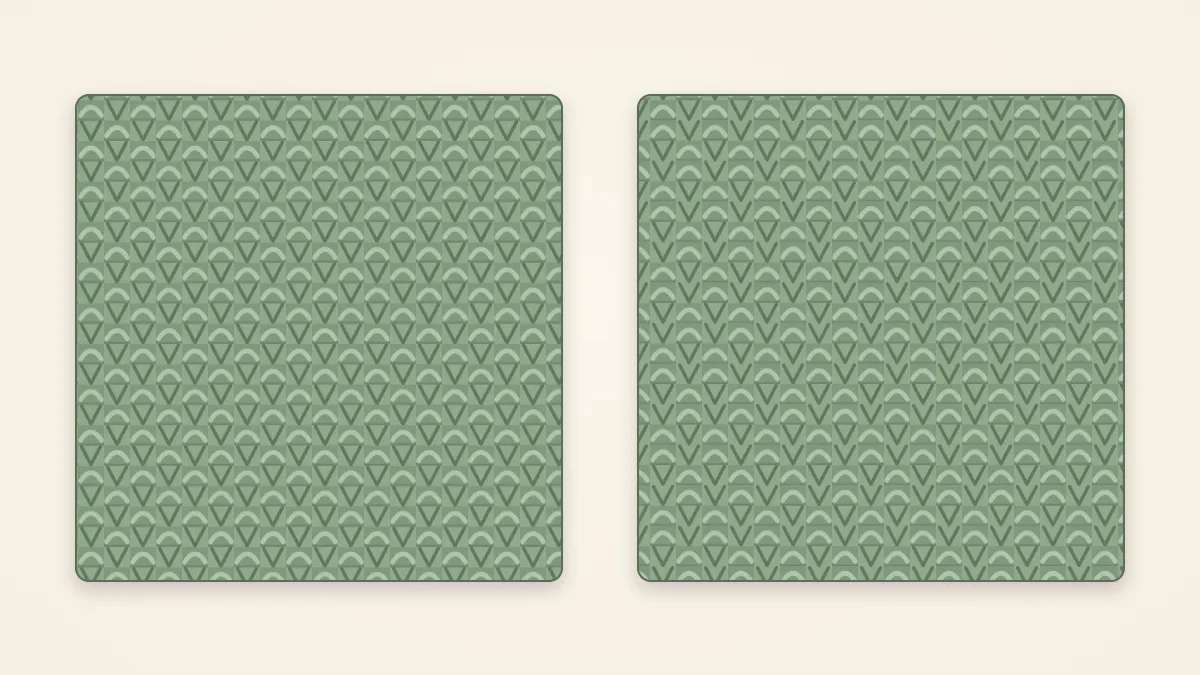
- Look at the picture or chart. A fine checkerboard of single stitches is seed stitch. Pairs of rows that step sideways are moss stitch.
If all three leave you unsure, knit a small swatch both ways and compare it with the sample shown. For a scarf, the practical cost of guessing wrong is small: the stitch count differs by at most one stitch, the width is the same, and both fabrics lie flat. For more options beyond these two, the overview of the best stitches for scarves compares them with garter, rib and basketweave.
Frequently asked questions
Are moss stitch and seed stitch the same thing?
In UK patterns, yes: moss stitch is the UK name for US seed stitch. In US patterns they differ, with seed stitch changing on every row and moss stitch changing every second row.
Is moss stitch harder to knit than seed stitch?
Not really. Moss stitch has a four-row repeat instead of one or two rows, but every wrong-side row is simply worked as the stitches appear, so many knitters find it just as easy.
Can I swap one stitch for the other in a scarf pattern?
Yes. Both lie flat and work to a similar width, so you only need to adjust the cast-on by one stitch: an odd number for one-row seed stitch, an even number for moss stitch.