How to Knit a Scarf for Beginners: Your First Scarf, Start to Finish
A complete first scarf in garter stitch: what to buy, how many stitches to cast on, the knit stitch step by step, keeping count, binding off and weaving in the ends.
Tutorial at a glance
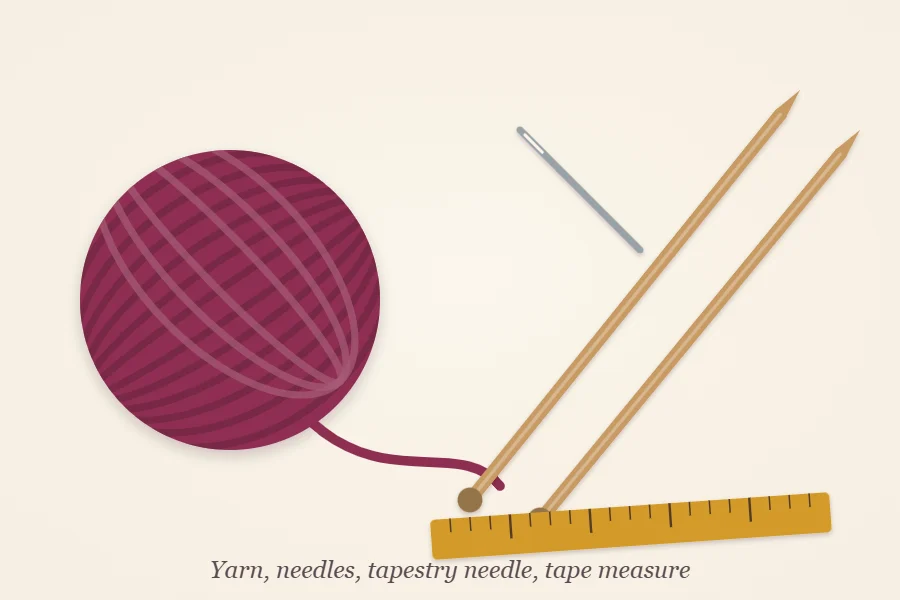
Materials
- Tapestry needle
- Scissors
- Tape measure
A first scarf asks for very little: one stitch, repeated until the fabric is long enough to wrap around a neck. The whole project is a rectangle, so there is no shaping, no sizing and no seam. What it does take is time and a steady stitch count, and both are easier when the yarn, the needles and the numbers are settled before you cast on. The plan below uses the simplest reliable setup: worsted-weight yarn, US 8 (5 mm) needles and garter stitch, which means knitting every stitch of every row.
What to Buy for a First Scarf
You need five things, and only the first two involve a decision.
- Yarn: worsted weight, marked #4 on the label, in a smooth texture and a light or medium solid color. A typical adult garter scarf of 7 x 65 in (18 x 165 cm) uses roughly 250-350 yd (230-320 m), so buy about 300 yd (275 m) or a little more, all from the same dye lot.
- Needles: one pair of US 8 (5 mm) straight needles, around 10 in (25 cm) long. Wood or bamboo grips the yarn slightly, which keeps stitches from sliding off while your hands are still learning.
- Tapestry needle: a blunt needle with a large eye, for weaving in the yarn tails.
- Scissors and a tape measure.
Dark, fuzzy or highly textured yarn hides the stitches you are trying to read, so save it for a later project. The guide to the best yarn for scarves covers fiber and softness in detail, and the article on needle size for scarves explains what changes when you go up or down a size.
The Numbers: Width, Length and Cast-On
Worsted yarn knit in garter stitch on US 8 (5 mm) needles usually comes out at about 4 stitches per inch (16 stitches over 4 in / 10 cm). For a scarf 7 in (18 cm) wide, the arithmetic is 7 x 4 = 28 stitches. That is the cast-on number for this scarf.
For length, aim for about 65 in (165 cm). A common rule of thumb is a scarf about as long as the wearer is tall, and most adult scarves fall between 60 and 70 in (150-180 cm). The scarf width and length guide has dimensions for children and other styles.
Your own gauge may differ. After 3 in (8 cm) of knitting, lay the piece flat and measure across it. If it is 8 in (20 cm) wide, you are getting 28 / 8 = 3.5 stitches per inch. You can keep going, since 8 in is still a normal scarf width, or restart with 7 x 3.5 = 24.5, rounded to 24 or 25 stitches.
Casting On
Cast on (CO) 28 stitches (sts) with whichever method you have learned. The long-tail cast-on is the usual first choice. It needs a tail measured out before you start: allow roughly 1 in (2.5 cm) per stitch plus 6 in (15 cm) to weave in later, which is about 34 in (86 cm) here. The knitted cast-on works too and needs no estimate, only a 6 in (15 cm) tail.
Watch out
A tight cast-on makes the bottom edge narrower than the rest of the scarf. Leave a little space between the stitches as you form them, and do not tug the yarn after each one. The loops should slide along the needle without resistance.
Count the stitches on the needle before you go on. Twenty-eight now saves a lot of confusion later.
The Knit Stitch, Row After Row
Hold the needle with the stitches in your left hand and the empty needle in your right. The working yarn, the strand that runs to the ball, hangs at the back of the work.
- Insert the tip of the right needle into the first stitch on the left needle, from left to right and from front to back, so the right needle sits behind the left one.
- Wrap the working yarn counterclockwise around the tip of the right needle, bringing it between the two needles.
- Draw the right needle back toward you, pulling the wrapped yarn through the old stitch as a new loop.
- Slide the old stitch off the left needle. One stitch is knit (k).
Repeat across all 28 stitches. When the left needle is empty, the row is finished: swap the needles between your hands, so the full one is on the left again, and knit the next row the same way. That is the entire pattern. Garter stitch worked flat is simply knit every row, and it produces a thick fabric that lies flat and looks the same on both sides.
Early rows are always the slowest and the least even. Keep going for 2 or 3 in (5-8 cm) before judging the fabric.
Keeping Count: Stitches and Ridges
Garter stitch forms horizontal ridges. Each ridge is made by two rows, one worked in each direction, so counting ridges and doubling the number gives you the row count.
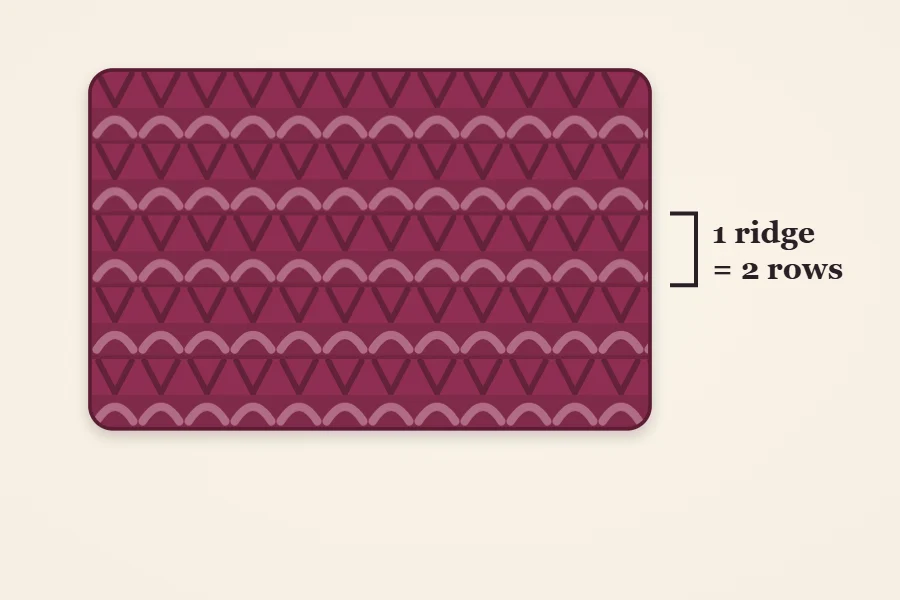
More useful than counting rows is counting stitches. Every few rows, count the loops on the needle. If there are still 28, the edges will be straight. If there are 29 or 30, a stitch has been added by accident, most often at the very start of a row, where the working yarn pulled up over the needle makes the first stitch look like two. That problem and its fix are covered in the list of common beginner scarf mistakes.
At a typical gauge, worsted garter has about 4 ridges per inch, so 65 in (165 cm) is roughly 260 ridges or 520 rows. Nobody needs to count that far. Lay the scarf flat without stretching it and use the tape measure.
Joining a New Ball
When the first ball is nearly finished, change at the start of a row, never in the middle. Drop the old yarn with a tail of at least 6 in (15 cm), pick up the new yarn leaving the same length, and knit the row with it. The first stitch will feel loose. Leave it alone for now, because weaving in the two tails later tightens it.
Tip
Not sure the yarn will reach the end of the row? A row of garter takes roughly three times the width of the scarf in yarn. For a 7 in (18 cm) scarf, start a new row only if about 21 in (53 cm) remains, plus the tail.
Binding Off and Weaving In Ends
When the scarf measures 65 in (165 cm), stop at the end of a row with a strand left that is at least four times the width of the scarf, about 28 in (71 cm). Then bind off (BO):
- Knit 2 stitches.
- With the left needle tip, lift the first stitch you knit over the second one and off the right needle. One stitch is bound off.
- Knit 1 more stitch and lift the previous stitch over it.
- Repeat step 3 until a single stitch remains. Cut the yarn, leaving 6 in (15 cm), and pull the tail through that last loop.
Work the bind-off as loosely as the cast-on, for the same reason: a tight edge pulls the end of the scarf in.
Thread each tail onto the tapestry needle and run it through the bumps along a garter ridge for 2 in (5 cm) or so, then back in the other direction for a few stitches. Because both sides of a scarf are visible, it is worth learning how to weave in ends so they disappear. Trim what is left, and the scarf is finished.
Frequently asked questions
How many stitches should I cast on for a beginner scarf?
With worsted-weight yarn and US 8 (5 mm) needles, 28 stitches gives a scarf about 7 in (18 cm) wide at a typical garter gauge of 4 stitches per inch. For another width, multiply the inches you want by your own stitches per inch.
How long does it take to knit a first scarf?
It depends on your pace and how often you knit. A full-length garter scarf is roughly 500 rows, so most beginners spread it over several weeks of short sessions rather than a weekend.
Do I need to learn the purl stitch to make a scarf?
No. Garter stitch uses only the knit stitch on every row, and it lies flat and looks the same on both sides, which is why it is the usual first scarf.