Scarf Width and Length Guide: How Wide and Long to Knit a Scarf
Typical scarf widths and lengths for children and adults, the height rule of thumb, and how to work out a cast-on number for the width you want.
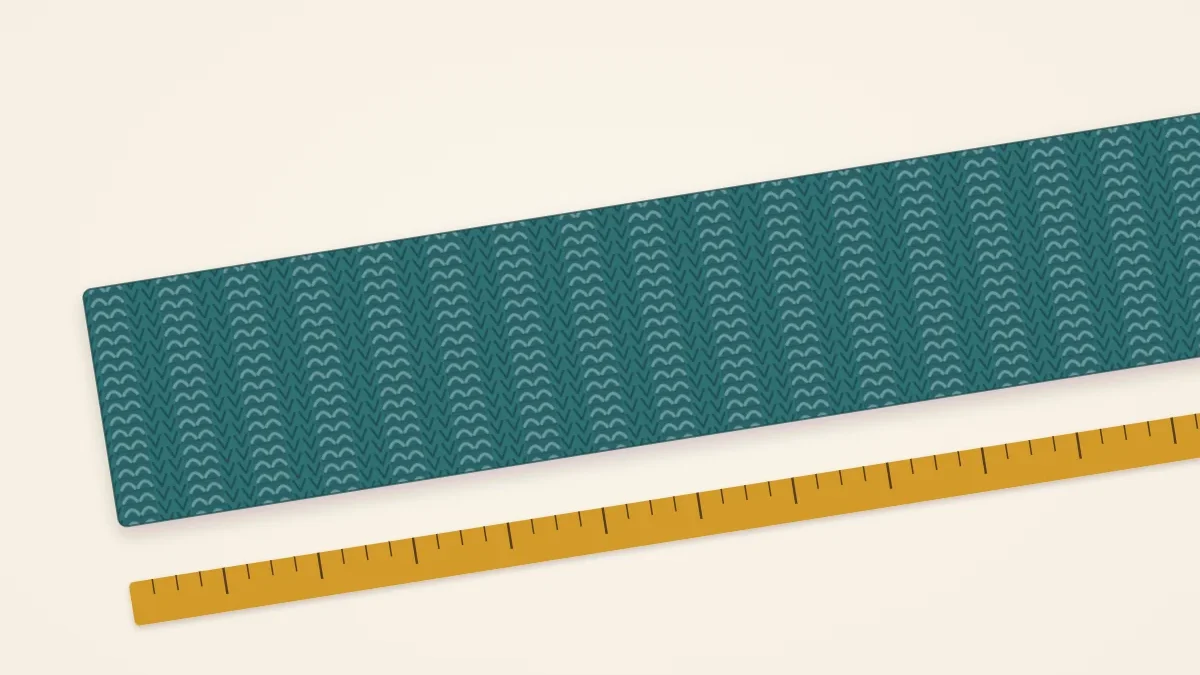
Most adult scarves land in a narrow band of sizes: 6-8 in (15-20 cm) wide and 60-70 in (150-180 cm) long. Inside and around that band, a few inches either way change how the scarf wears, how long it takes and how much yarn it needs. Deciding both numbers before you cast on is easier than discovering at 50 in that you wanted a scarf that wraps twice.
How long should a scarf be?
Length decides how the scarf can be worn. A short one hangs or tucks into a coat; a long one wraps.
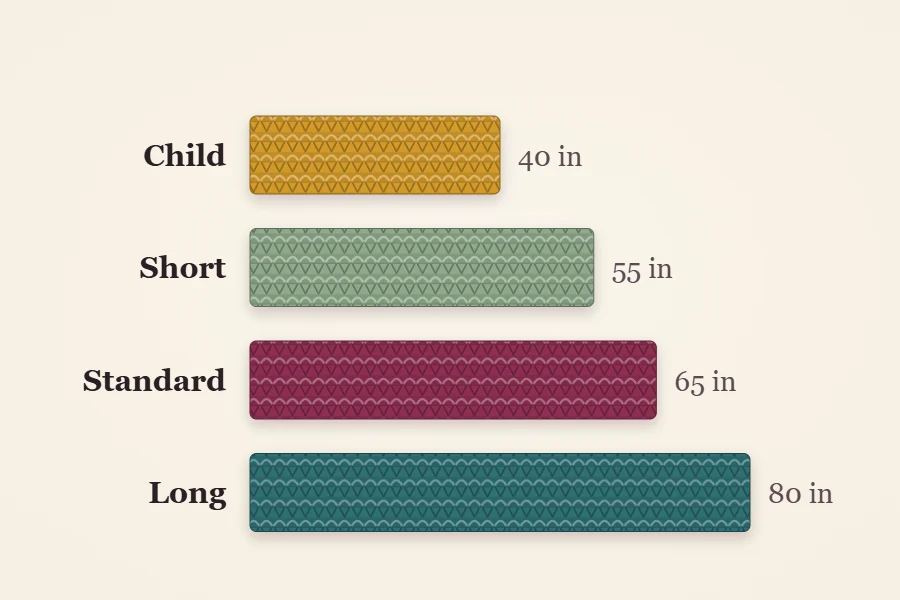
| Length | Measurement | How it wears |
|---|---|---|
| Child | 40 in (102 cm) | Crosses once at the front; nothing long enough to trail or catch |
| Short | 55 in (140 cm) | Hangs straight, crosses over the chest or tucks inside a coat |
| Standard | 65 in (165 cm) | Wraps once around the neck with both ends hanging, or folds in half and loops through itself |
| Long | 80 in (203 cm) | Wraps twice around the neck, or wraps once with long ends |
The 65 in standard sits in the middle of the typical 60-70 in adult range. The child length of 40 in sits inside the typical child range of 36-48 in (90-120 cm); use the shorter end for a small child and the longer end for an older one.
The height rule of thumb
A common rule is to make a scarf about as long as the wearer is tall. It works because the length needed to go around the neck and hang to a comfortable point scales with the body. Someone who is 5 ft 4 in is 64 in (163 cm) tall, which points to the standard length. Someone who is 6 ft is 72 in (183 cm) tall, and a 65 in scarf will feel a little short on them once it is wrapped.
Use the rule as a starting point and adjust for style:
- For a scarf that only tucks into a coat, subtract about 10 in (25 cm).
- For a scarf that wraps twice, add about 15 in (38 cm).
- For thick yarn, stay near or slightly under height; a long super bulky scarf is heavy.
If you are knitting for someone whose height you do not know, 65 in is the safe choice for an adult.
How wide should a scarf be?
Width decides how much of the neck is covered, how bulky the scarf feels when wrapped and, more than anything else, how long the project takes. Every extra inch of width is added to every row.
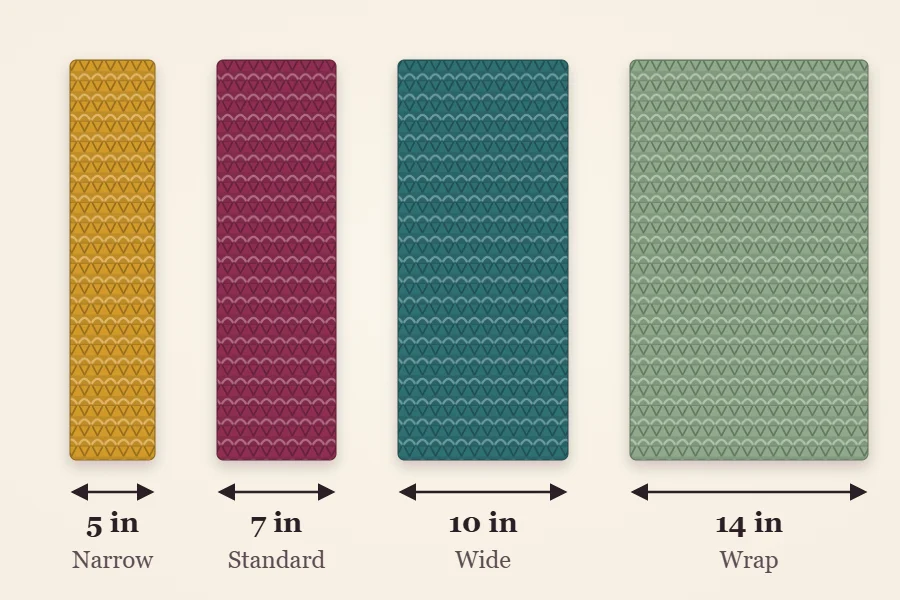
| Width | Measurement | Best for |
|---|---|---|
| Narrow | 5 in (13 cm) | Children, light accent scarves, thick yarn where a wider fabric would be bulky |
| Standard | 7 in (18 cm) | Everyday adult scarves in any yarn weight |
| Wide | 10 in (25 cm) | Cold-weather scarves that cover the neck and chin and can be folded double |
| Wrap | 14 in (36 cm) | Scarves worn over the shoulders like a small shawl |
The 5 in narrow width also falls in the typical child range of 4-6 in (10-15 cm). A wide or wrap-width scarf in worsted yarn is a much larger project than it sounds: a 14 in wrap has exactly twice as many stitches in every row as a 7 in scarf.
Width and length together decide the yarn
Yarn use follows the area of the fabric, which is width multiplied by length. A standard 7 x 65 in scarf has an area of 455 square inches. A wide, long 10 x 80 in scarf has 800 square inches, about 1.75 times as much, so it needs about 1.75 times the yarn in the same stitch and gauge. A child’s 5 x 40 in scarf has 200 square inches, a little under half of the standard.
That is worth knowing before you buy. The guide to how much yarn a scarf needs gives the typical ranges by yarn weight and shows how to scale them.
Casting on for a target width
To turn a width into a number of stitches, you need your gauge: how many stitches you get per inch with your yarn, your needles and your stitch pattern. Then the arithmetic is one line:
stitches to cast on = target width in inches x stitches per inch
The table uses three example gauges in garter stitch. Yours may differ, which is why a quick gauge swatch is worth the time.
| Target width | Worsted at 4 stitches per inch | Bulky at 3 stitches per inch | Super bulky at 2 stitches per inch |
|---|---|---|---|
| Narrow, 5 in | 20 | 15 | 10 |
| Standard, 7 in | 28 | 21 | 14 |
| Wide, 10 in | 40 | 30 | 20 |
| Wrap, 14 in | 56 | 42 | 28 |
If your stitch pattern needs a particular multiple, move to the nearest number that fits. A 2×2 rib that starts and ends with two knit stitches needs a multiple of 4 plus 2, so 28 stitches becomes 30 (4 x 7 = 28, plus 2). Seed stitch worked the same on every row needs an odd number, so 28 becomes 27 or 29. One or two stitches change the width by a fraction of an inch.
How stretch changes the numbers
Knitted fabric is not a fixed size, and scarves are pulled in one direction every time they are worn.
- Garter stitch is compressed lengthwise, like a spring. Under its own weight it relaxes and gets longer, and slightly narrower. Heavy yarns, superwash wool and alpaca do this most.
- Ribbing pulls in sideways. A ribbed scarf needs more stitches than garter for the same relaxed width, and its width depends on how far it is stretched open. The 2×2 ribbed scarf pattern shows how to plan for that.
- Seed stitch and basketweave stay close to their knitted size.
Tip
To measure length while you knit, lay the scarf flat on a table without pulling it and measure from the cast-on edge to just below the needle. Then hold it up by the needle and measure again. The difference shows how much it is likely to grow when worn.
What blocking can and cannot change
Blocking sets the final size. Wool and other animal fibers respond well to wet blocking: once damp, the fabric can be eased a little wider or longer and pinned so the edges dry straight. Expect a modest change, not a rescue; a scarf that is 10 in too short will not block to length. Acrylic does not hold a wet block, so plan to knit an acrylic scarf to its finished size. The steps are in the guide to blocking a knitted scarf.
Scarves that are joined into a loop follow different numbers, because the measurement that matters is the circumference. Those are covered in the infinity scarf size guide.
Frequently asked questions
What is the standard size of an adult scarf?
A typical adult scarf is 6-8 in (15-20 cm) wide and 60-70 in (150-180 cm) long. A 7 x 65 in scarf is a safe choice when you do not know the wearer's preferences.
How long does a scarf need to be to wrap around twice?
About 80 in (203 cm) wraps twice around most adult necks with ends left to hang. In very thick yarn, a scarf that long is heavy, so consider a narrower width.
How many stitches do I cast on for a 7-inch-wide scarf?
Multiply 7 by your stitches per inch. At 4 stitches per inch that is 28 stitches, at 3 stitches per inch it is 21, and at 2 stitches per inch it is 14.