How Much Yarn for a Scarf? Yardage Estimates by Yarn Weight
Typical yardage for a knitted scarf by yarn weight, why ribbed and textured stitches need more, and how to weigh a swatch for a closer estimate.
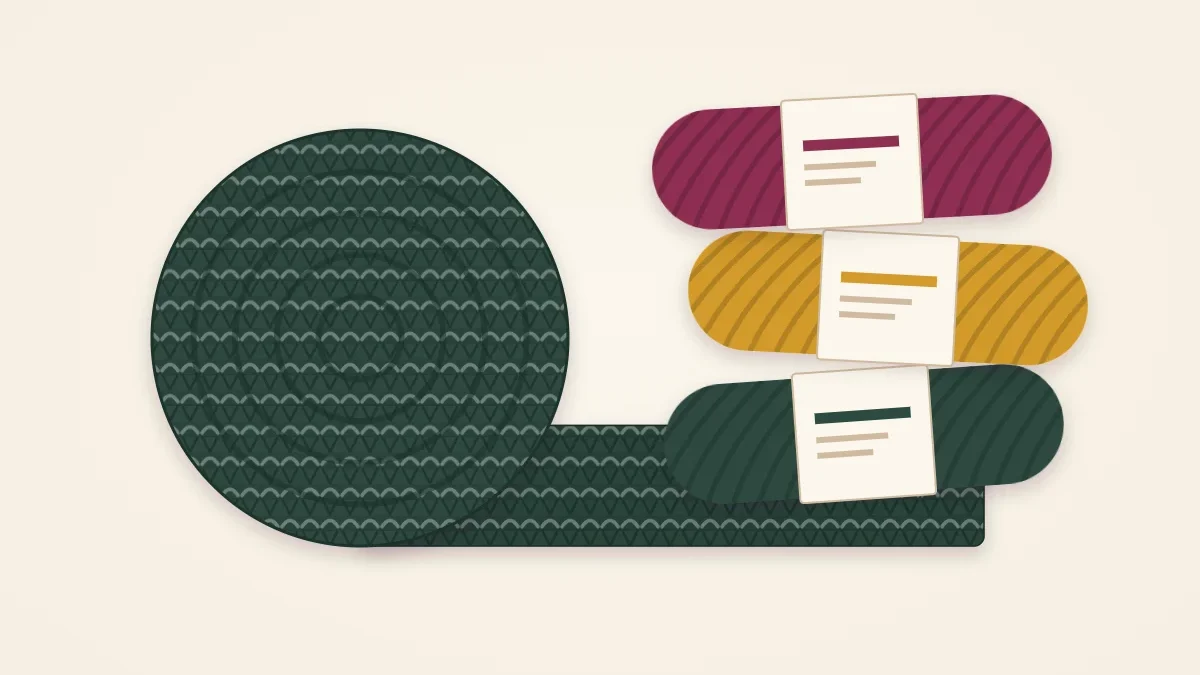
For a standard adult scarf, about 7 in (18 cm) wide and 65 in (165 cm) long in garter stitch, plan on roughly 250-350 yd (230-320 m) of worsted-weight yarn. Thicker yarn needs fewer yards and thinner yarn needs more. Every figure here is an estimate, because the real amount depends on your gauge, your stitch pattern and the exact size you knit, but a good estimate is enough to buy the right number of skeins.
Typical yardage by yarn weight
These ranges are for a 7 x 65 in scarf in garter stitch at a normal scarf gauge.
| Yarn weight | Estimated yardage | Estimated meters |
|---|---|---|
| Worsted (#4) | 250-350 yd | 230-320 m |
| Bulky (#5) | 180-250 yd | 165-230 m |
| Super bulky (#6) | 120-180 yd | 110-165 m |
DK (#3) yarn is thinner than worsted, so the same scarf takes more of it; expect to go beyond the top of the worsted range. The ranges are wide because knitters differ. A loose knitter on larger needles covers more area with each yard than a tight knitter on smaller ones.
Buy by yardage, not by weight or by number of skeins. Two skeins that both weigh 100 g can hold very different lengths depending on the fiber and how thick the strand is. The yardage is printed on the label; the guide to the best yarn for scarves explains what else to read there.
Why the stitch pattern changes the amount
The ranges above assume garter stitch. Other stitches cover a different amount of area with the same yarn.
- Ribbing uses the most. Rib pulls in sideways, so you need more stitches to reach the same width, and all of those extra stitches use yarn in every row.
- Seed stitch, moss stitch and basketweave use somewhat more than garter, because the yarn travels back and forth between knit and purl stitches.
- Open fabrics, such as a thin yarn knit on large needles, use less, because each stitch covers more area.
There is no single correction factor that is right for every yarn and knitter. For a ribbed or heavily textured scarf, a reasonable planning allowance is about a quarter more than the garter estimate, and the swatch method below will give you a far better number than any rule.
Adjusting for a different size
Yarn use follows the area of the fabric: width multiplied by length. A 7 x 65 in scarf covers 455 square inches. To scale an estimate, divide the new area by 455 and multiply the yardage by the result.
| Scarf size | Area | Compared with 7 x 65 in | Worsted estimate in garter |
|---|---|---|---|
| Child, 5 x 40 in | 200 sq in | about 0.44 times | roughly 110-155 yd (100-140 m) |
| Standard, 7 x 65 in | 455 sq in | 1 time | roughly 250-350 yd (230-320 m) |
| Wide and long, 10 x 80 in | 800 sq in | about 1.76 times | roughly 440-615 yd (400-560 m) |
The jump from standard to wide and long catches people out: three extra inches of width and fifteen of length come close to doubling the yarn. If you are still deciding on dimensions, the scarf width and length guide covers the common sizes.
The weigh-your-swatch method
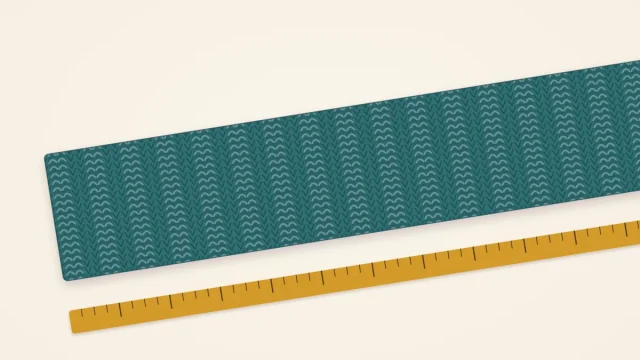
The most accurate estimate comes from your own knitting. You need a swatch in the yarn, needles and stitch pattern of the scarf, a ruler, and a kitchen scale that reads in grams.
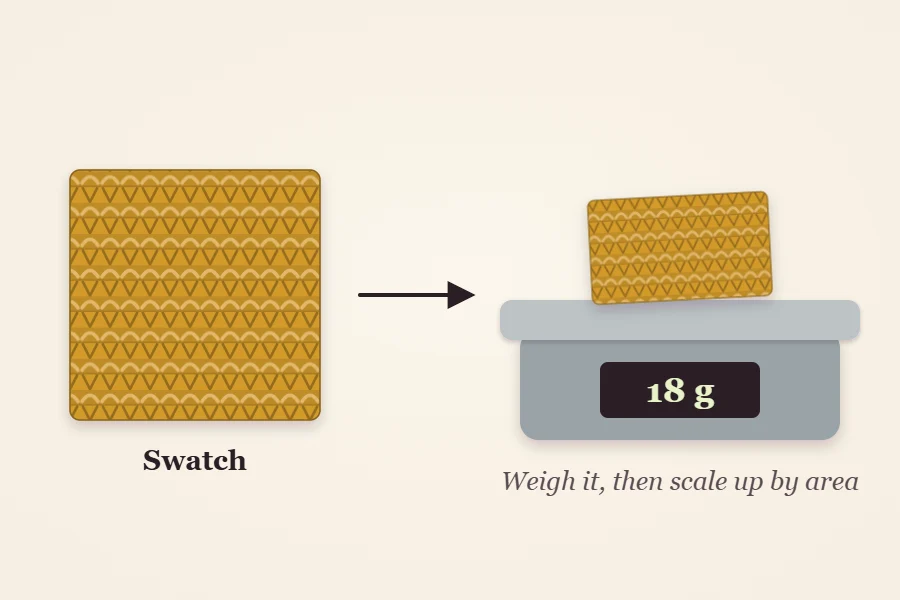
- Measure the swatch. Multiply its width by its height to get the area. A swatch 6 in wide and 6 in tall is 36 square inches.
- Weigh it. Say it weighs 10 g, including its cast-on and bind-off edges.
- Find grams per square inch. 10 divided by 36 is about 0.278 g per square inch.
- Multiply by the scarf’s area. For 7 x 65 in, that is 455 x 0.278, which is about 126 g.
- Convert grams to yards using the label. If the label says 220 yd (201 m) per 100 g, the yarn runs 2.2 yd per gram. 126 x 2.2 is about 278 yd (254 m).
- Add a margin of 10 to 15 percent. Ten percent more than 278 is about 306 yd, so two 220 yd skeins, 440 yd in total, cover the scarf comfortably.
A bigger swatch gives a better answer. Most kitchen scales read to the nearest gram, and one gram is a tenth of a 10 g swatch, so a small rounding error is multiplied across the whole scarf. If you are going to knit a gauge swatch anyway, make it generous and use it for both jobs.
Tip
Already knitting? When your first skein runs out, measure the length it produced. Divide your target length by that number to see how many skeins the whole scarf will take.
What else uses yarn
The body of the scarf is not the only thing that uses yarn. Allow for these too:
- The bind-off. Leave a strand about 4 times the scarf width to bind off. For a 7 in scarf that is 4 x 7 = 28 in (71 cm).
- Tails. Each end you weave in should be at least 6 in (15 cm) long, and every new skein or color change adds two of them.
- Fringe. Fringe is cut from the same yarn and can take a surprising amount. The guide to adding fringe to a scarf shows how to work out the amount before you cut.
- The swatch, unless you unravel it and reuse the yarn.
Buy one extra skein, from the same dye lot
Yarn is dyed in batches, and each batch gets a dye lot number printed on the label. Two skeins of the same color name from different lots can differ slightly in shade. Side by side in a scarf, that difference shows as a visible line where one skein ends and the next begins.
For that reason, buy everything you need at once and check that the lot numbers match. If your estimate lands close to a whole number of skeins, buy one more. Running out a few inches from the end, and then finding the lot is sold out, is a worse outcome than having a spare skein.
Watch out
Some stores accept returns of unused, unwound skeins and some do not. Ask before buying extra, and keep the label band on any skein you might take back.
If you would rather let the yarn decide the size, turn the problem around: buy a single generous skein and knit until it is nearly gone. The one-skein scarf shows how to choose a width so the length works out.
Frequently asked questions
How many skeins of yarn do I need for a scarf?
It depends on the yardage per skein, so check the label. A standard adult garter scarf in worsted yarn takes roughly 250-350 yd (230-320 m), which is usually two skeins of about 200 yd each.
Does a chunky scarf use less yarn?
In yards, yes: super bulky yarn needs roughly 120-180 yd (110-165 m) for a standard scarf. Thick yarn comes in shorter skeins, though, so you may still need several.
What happens if I mix dye lots in one scarf?
The shades can differ slightly, and the change may show as a visible line across the scarf. Buy all the yarn for one project from the same lot whenever you can.