Gauge Swatch for Scarves: When You Need One and How to Measure It
When a gauge swatch is worth knitting for a scarf, how to knit and measure it, and how to turn stitches per inch into a cast-on number.
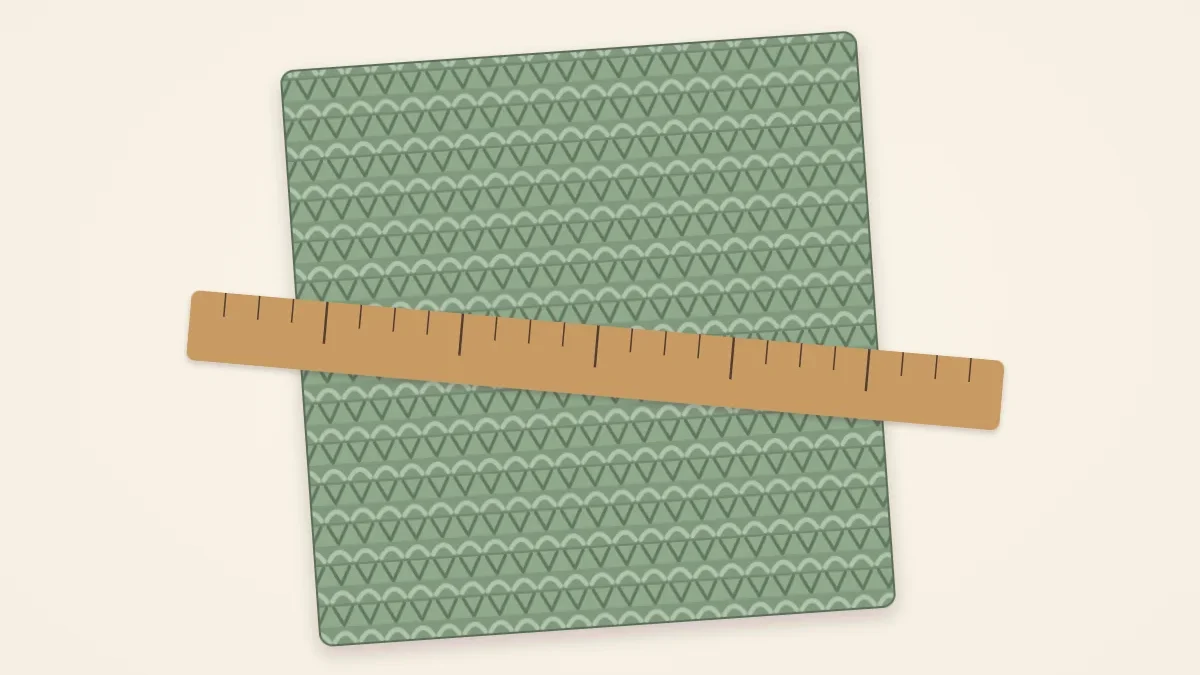
Gauge is the number of stitches and rows that fit into a measured piece of your knitting, usually stated over 4 in (10 cm). A gauge swatch is the small test square you knit to find that number. Sweater knitters swatch because a wrong gauge means a garment that does not fit. A scarf has no fit to get wrong, so the honest question is whether the swatch is worth half an hour of your time.
Do you need a gauge swatch for a scarf?
Not always. If you are knitting a plain garter scarf, you are happy with whatever width comes out, and you have yarn to spare, you can cast on and treat the first few inches as your swatch. If the width is wrong, you pull it out and start again having lost very little.
A swatch earns its place in these situations:
- You want a specific width. Without gauge, the cast-on number is a guess.
- Yarn is limited. A scarf that comes out an inch wider than planned uses noticeably more yarn and may end up too short.
- You are substituting yarn or needles in a pattern written for something else.
- You are not sure about the fabric. A swatch shows whether it is stiff, floppy or right before you have knit two feet of it.
- The stitch pattern is new to you. A swatch is a low-stakes place to practice it.
Half a stitch per inch sounds trivial, but it adds up. Twenty-eight stitches at 4 stitches per inch make a scarf 7 in wide. The same 28 stitches at 4.5 stitches per inch make a scarf about 6.2 in wide (28 divided by 4.5).
How to knit the swatch
- Use the same yarn, the same needles and the same stitch pattern you plan to use for the scarf. Gauge in garter stitch tells you nothing reliable about gauge in rib.
- Cast on enough stitches for about 6 in (15 cm) of width. In worsted-weight (#4) yarn on US 8 (5 mm) needles, 24 to 28 stitches is about right. In super bulky yarn, 12 to 14 is enough.
- Knit until the piece is 5-6 in (13-15 cm) tall. The swatch has to be larger than the area you measure, because edge stitches and the rows next to the cast-on are distorted.
- Bind off loosely, or slip the stitches onto a spare length of yarn, so the top edge does not pull the fabric in.
Knit the swatch in the mood and position you normally knit in. Careful, tense “test” knitting gives a tighter gauge than the relaxed knitting you will do on row 200. If the fabric itself feels wrong, change needles before measuring anything; the needle size guide explains which direction to go.
Wash it the way you will wash the scarf
Yarn changes the first time it gets wet. Wool relaxes and blooms, superwash wool often grows, and cotton can tighten or lengthen. If you plan to wet block the scarf, soak the swatch, press the water out in a towel, lay it flat without stretching it and let it dry completely before measuring. The process is the same as blocking the finished scarf, just smaller.
If the scarf is acrylic and will go through the washing machine, wash and dry the swatch that way. If you never intend to block the scarf at all, measure the swatch as it comes off the needles after letting it rest flat for a while.
How to measure stitches per inch
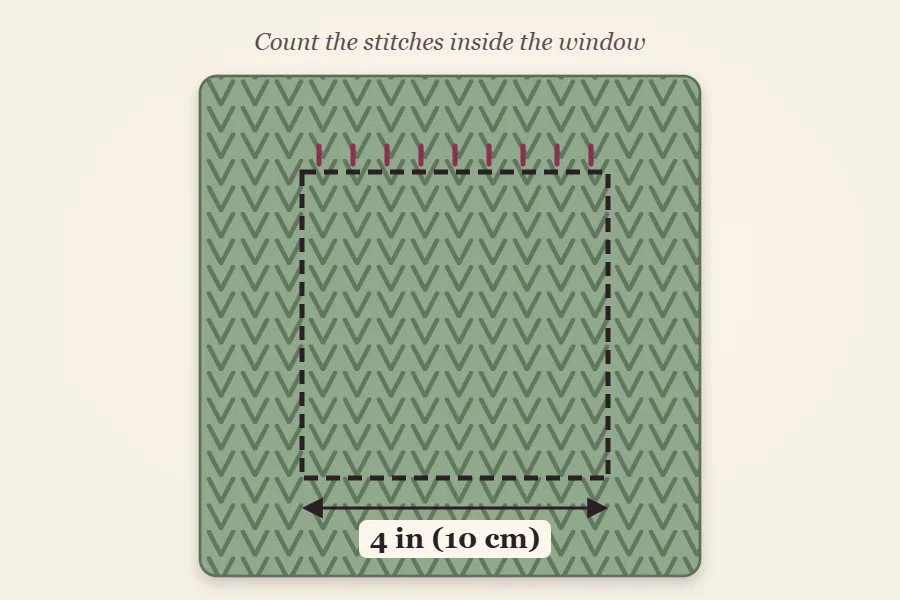
- Lay the swatch on a hard, flat surface. Do not stretch or pin it.
- Place a ruler or tape measure horizontally across the middle, following one row.
- Mark the 0 and 4 in points with two pins.
- Count every stitch between the pins, including half stitches.
- Divide by 4. That is your stitches per inch.
For example, 18 stitches in 4 in is 4.5 stitches per inch. If you count 17 and a half, that is 4.375 stitches per inch; keep the fraction until the final step.
Counting is easiest in good light with a light-colored yarn. In garter stitch, follow a single ridge and count the upper bumps along it; each one is a stitch. In rib, the purl columns hide between the knit columns, so open the fabric gently to the width you expect it to have when worn, then count both the knit and the purl stitches.
Watch out
Do not measure from edge to edge and divide by the number of stitches you cast on. Edge stitches are looser and wider than the ones in the middle, so the result comes out wrong.
From stitches per inch to a cast-on number
The formula is short:
cast-on stitches = target width in inches x stitches per inch
With a gauge of 4.5 stitches per inch and a target width of 7 in, that is 7 x 4.5 = 31.5. You cannot cast on half a stitch, so round to 31 or 32. Which one depends on the stitch pattern, because many patterns need a particular multiple.
| Stitch pattern | Stitch count it needs | Nearest to 31.5 | Check |
|---|---|---|---|
| Garter stitch | Any number | 32 | No multiple required |
| Seed stitch | Odd number | 31 | 31 is odd |
| 1×1 rib | Odd number | 31 | 31 is odd |
| 2×2 rib | Multiple of 4, plus 2 | 30 or 34 | 4 x 7 + 2 = 30; 4 x 8 + 2 = 34 |
| Mistake rib | Multiple of 4, plus 3 | 31 | 4 x 7 + 3 = 31 |
Remember that the gauge has to come from a swatch in that same stitch pattern; the table only shows how one result of 31.5 would be rounded for each. Rib pulls in, so for a ribbed scarf choose the larger of two options when you are between them. The 2×2 ribbed scarf pattern works through a full example, and the width and length guide helps you choose the target width in the first place.
What about row gauge?
Row gauge is the number of rows per inch, measured the same way with the ruler turned vertically. For a scarf it matters much less than stitch gauge, because you simply knit until the scarf is as long as you want.
It is still useful for planning. In garter stitch, two rows make one ridge, so count ridges and double them. If you count 18 ridges in 4 in, that is 36 rows, or 9 rows per inch. A 65 in scarf at that gauge is 65 x 9 = 585 rows, which is roughly 292 ridges. Knowing that helps you space stripes evenly or judge how far a ball of yarn will go.
Put the swatch to work
Do not throw the swatch away. Weighed on a kitchen scale, it tells you how much yarn each square inch of your fabric uses, which is the most accurate way to estimate how much yarn the whole scarf needs. It is also a safe place to test washing and blocking before you risk the finished piece. And if you run short at the end, you can unravel it and use the yarn.
Frequently asked questions
Can I skip the gauge swatch for a scarf?
Yes, if the exact width does not matter and you have plenty of yarn. Knit the first few inches, measure the width, and start again if you do not like it.
How big should a gauge swatch be?
Make it about 6 in (15 cm) wide and 5-6 in (13-15 cm) tall, so you can measure a full 4 in (10 cm) in the middle without including the distorted edge stitches.
What if my stitch count per inch is not a whole number?
Keep the fraction, multiply it by your target width, and round only the final answer. For example, 4.5 stitches per inch times 7 in is 31.5, which you round to 31 or 32.